
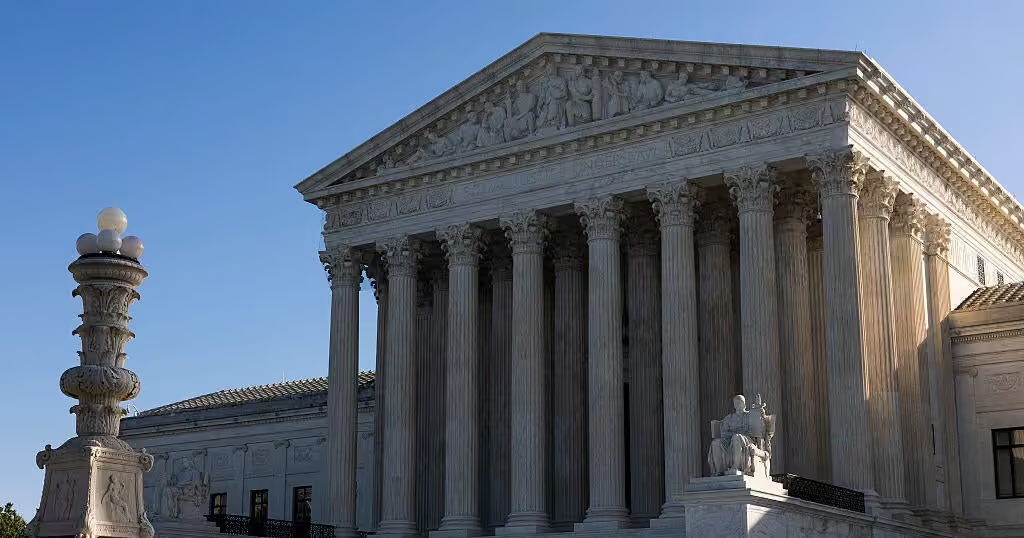
Following years of advocacy for Supreme Court reform , driven by landmark rulings on abortion, presidential authority, and voting rights , Democrats appear positioned to advance their judicial reform agenda after securing control of both the House and Senate in the midterm elections.
Democrats are projected to hold at least 54 Senate seats and at least 250 seats in the House, affording them the legislative leverage to pursue measures that had no viable path forward under Republican-controlled Congress.
Although Democrats have yet to formally announce their legislative priorities for the incoming Congress, House Democratic Leader Hakeem Jeffries , widely expected to be elected Speaker in January , has made clear that the Supreme Court remains a central concern.
“We must root out corrupt price gouging, clean up the mess at the Supreme Court and ban Members of Congress from trading stocks,” he wrote in a letter to Democratic colleagues formally declaring his candidacy for the speakership. “Accountability begins at home.”
In an August appearance on NBC’s “Meet the Press,” Jeffries stated that “dramatic” reform of the Supreme Court is necessary, and indicated that Democratic Rep. Jamie Raskin , who is expected to chair the House Judiciary Committee in the next Congress , would take the lead on such efforts. A spokesperson for Raskin did not respond to a request for comment.
Over the years, Democrats have put forward a range of proposals intended to reshape the Supreme Court, including the introduction of term limits for justices, the establishment of comprehensive ethics rules, and the expansion of the Court’s membership.
During the first two years of the Biden administration, when Democrats last held congressional majorities, the House passed legislation that would have imposed ethics requirements on Supreme Court justices. However, the measure failed to advance in the Senate.
Former President Joe Biden also convened a commission charged with examining proposals to reform the high court. The panel, however, stopped short of recommending structural changes, instead presenting the arguments both for and against various potential reforms.
Calls for Supreme Court reform have intensified since Democrats were last in power, particularly as the Court’s conservative majority has moved to overturn long-established legal precedents and broaden executive authority.
With Democrats now holding a majority in the House, members are positioned to advance legislation that would impose meaningful changes on the high court. Nevertheless, such measures are unlikely to clear the Senate, where most legislation requires 60 votes to proceed. Democrats are expected to control between 54 and 56 seats. Furthermore, even if court-reform legislation were to pass both chambers, it remains uncertain whether President Trump would sign such measures into law.
The following are among the proposals that Democrats may pursue in the next Congress:
Ethics reforms
Legislative efforts to compel the Supreme Court to adopt a formal code of conduct gained significant traction in 2023, following a series of investigative reports by ProPublica detailing Justice Clarence Thomas’s travel arrangements with a wealthy Republican donor , trips that had been omitted from his financial disclosures.
In the wake of those revelations, the Senate Judiciary Committee advanced legislation that would require the Supreme Court to adopt an ethics code and establish procedures for addressing misconduct complaints. However, the proposal, sponsored by Sen. Sheldon Whitehouse, a Democrat from Rhode Island, failed to receive a vote before the full Senate.
Whitehouse reintroduced the proposal in May 2025. Rep. Hank Johnson, a Democrat from Georgia, introduced companion legislation in the House.
The Whitehouse-Johnson legislation would also require the Supreme Court to establish disclosure rules governing gifts, income, and reimbursements, including a provision mandating that parties to a case or individuals filing amicus briefs disclose any gifts made to the justices.
Democratic Sen. Cory Booker of New Jersey and Rep. Daniel Goldman of New York introduced separate legislation that would require the Supreme Court to create an internal Office of Ethics Counsel and an Office of Investigative Counsel. The investigative counsel would be responsible for reviewing and investigating ethics complaints filed against the justices.
A measure introduced by Rep. Jamie Raskin of Maryland and Rep. Alexandria Ocasio-Cortez of New York would prohibit federal judges and Supreme Court justices from accepting gifts valued at more than $50.
The Supreme Court did adopt its own internal code of conduct in November 2023; however, the absence of any enforcement mechanism prompted renewed calls for Congress to intervene.
Beyond the Supreme Court, a Democrat-led Congress could also examine allegations of misconduct involving federal judges on the lower courts that have recently come to light, according to Gabe Roth, executive director of Fix the Court, an organization that advocates for judicial reform at both the Supreme Court and lower court levels.
Several federal judges have faced accusations of mistreating their law clerks, while others have been subject to investigations for alleged misconduct.
U.S. District Judge Eleanor Ross of Georgia received a private reprimand following an investigation that determined she had engaged in a sexual encounter with a police officer in her chambers. Republican Rep. Andrew Clyde of Georgia has since filed articles of impeachment against her.
U.S. District Judge Ada Brown of Texas is currently facing judicial conduct proceedings after being accused of directing racial insults at an attorney, fellow judges, and court staff, as well as recusing herself from dozens of cases without explanation or for reasons described as “unusual.”
“There’s 2,400 federal judges, so there’s going to be a few bad apples, but if we’re going to talk about cleaning up the government, we can’t leave out the third branch,” Roth said.
Roth also noted that congressional Democrats could pursue legislation extending workplace discrimination and harassment protections to cover the judiciary , a concept that has previously garnered bipartisan support , as well as measures prohibiting Supreme Court justices and federal judges from trading stocks or participating in prediction markets.
“The larger issue is really in the lower courts and resetting the rules of the road and making it clear that while there may have been a focus on the Supreme Court over the last three years, the lower courts really shouldn’t be immune from this anticorruption push,” he said.
Term limits
Article III of the Constitution provides that Supreme Court justices and lower court judges shall hold their offices “during good behavior,” a provision that has long been interpreted to confer lifetime tenure upon federal judges.
Nonetheless, Democratic members of Congress have argued that justices should be subject to term limits, and have introduced various proposals to establish such limitations through both legislation and constitutional amendments.
Several bills introduced in the House would impose 18-year term limits on justices and create a system of regular appointments tied to specific years within a presidential term.
One such proposal, a constitutional amendment introduced by Maryland Democratic Rep. Johnny Olszewski, would require sitting justices who have served more than 18 years to retire. Chief Justice John Roberts, Justice Samuel Alito, and Justice Clarence Thomas have each served in excess of 18 years.
One term-limit proposal originates from a Republican lawmaker, Rep. Tom Barrett of Michigan, whose constitutional amendment would cap terms for both Supreme Court justices and lower court judges at 20 years.
Barrett did not retain his seat in Tuesday’s midterm elections.
Amending the Constitution requires Congress to pass a joint resolution with support from two-thirds of both the House and Senate, after which the proposed amendment must be ratified by three-fourths of the states , that is, 38 of the 50 states.
Expanding the Supreme Court
The Constitution does not specify the number of justices who must sit on the Supreme Court. Throughout the nation’s history, the size of the Court has been altered on six separate occasions, with membership ranging from a low of six justices to a high of ten. The Court has consisted of nine justices since 1869.
In recent years, however, a growing number of Democrats have called for expanding the Supreme Court, particularly in response to controversial rulings on abortion, regulatory authority, and presidential power.
One bill, introduced by Democratic Rep. Al Green of Texas, proposes expanding the Court from nine to thirteen justices. Previous proposals from Democrats in both the House and Senate have similarly called for the addition of four seats to the high court.