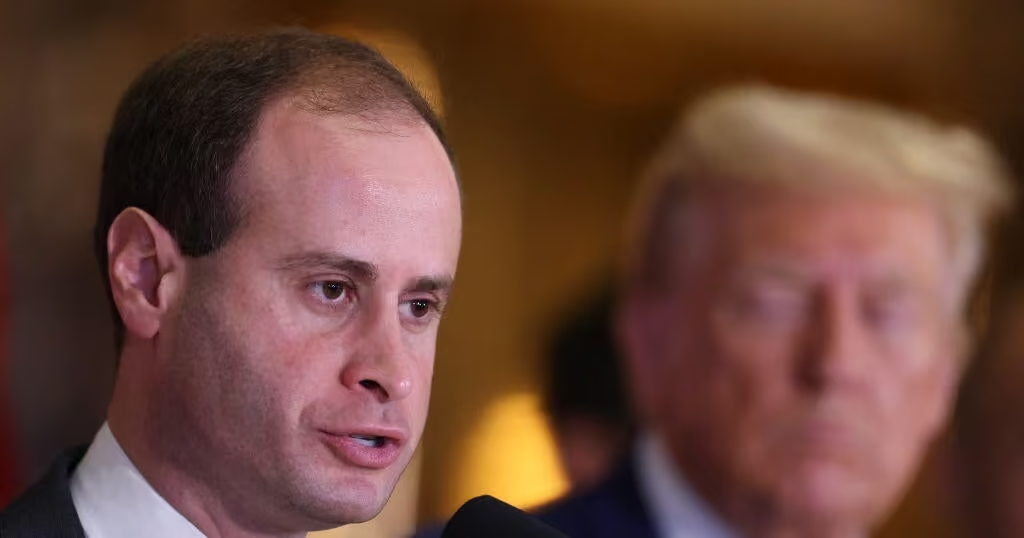
The top attorney at the White House has issued a stark warning to the leading Democrat on the House Oversight and Government Reform Committee, cautioning that planned congressional investigations into the Trump administration could “cross the line into blatant criminality.” White House Counsel Will Scharf further indicated that any congressional subpoenas issued may trigger investigations from the executive branch.
Scharf’s letter, addressed to Representative Robert Garcia , a California Democrat set to assume the chairmanship of the Oversight Committee in January , signals an escalating confrontation between the Trump administration and congressional Democrats. The latter are preparing to launch a series of investigations into matters arising during the first two years of President Trump’s second term.
In the letter, dated Monday, Scharf reminded Garcia that all investigative actions undertaken by Congress must be grounded in a “legitimate legislative purpose.”
“Beyond being inconsistent with the clear, well-recognized constitutional limitations on your investigative functions, threats to executive branch officials designed to deter them from public service, or process designed merely to abuse or instill fear in the recipient may cross the line into blatant criminality,” Scharf wrote. “And issuing unlawful subpoenas with the intention of depriving citizens of their constitutional rights and privileges may warrant further investigation.”
Scharf referenced recent public statements made by Democratic members of Congress in which they outlined their investigative intentions upon assuming control of both chambers. He contended that Democrats are determined to exceed the constitutional boundaries governing congressional investigations and the issuance of subpoenas.
“Abusive threats and public statements about the indiscriminate issuance of subpoenas, along with threats directed at prospective targets within the Administration make it abundantly clear that any forthcoming investigative processes will be deployed to harass and aggrandize rather than to advance any legitimate end,” he wrote.
Scharf further accused Democrats of making “abusive and capricious threats” and alleged that they are seeking to “abuse the legislative process to intimidate and to interfere with lawful functioning of government.”
In response, Garcia maintained that the White House is attempting to encroach upon his committee’s constitutionally protected oversight authority.
“It appears Donald Trump has something to hide,” the California Democrat stated. “Let’s be clear: Congress’ authority comes from Article I of the Constitution, not from the permission of the White House. Congress has wide latitude to conduct investigations and oversight, an authority inherent in the power to legislate.”
Garcia went on to accuse the Trump administration of weaponizing the executive branch against the legislative branch.
“We are a co-equal branch of government and will not be deterred by baseless threats from a weaponized DOJ or from the President’s lawyers,” he said.
House Democratic Leader Hakeem Jeffries, who is expected to assume the role of Speaker in January, told reporters that throughout the first two years of President Trump’s second term, the White House has grown accustomed to a Republican-led Congress that he described as a “reckless rubber stamp” for the president’s legislative agenda.
“A Democratic Congress is going to be a check and balance on an out-of-control executive branch in the face of unprecedented corruption that they’ve unleashed on the American people, and if they don’t like it, consult the Constitution,” he said.
Molly Nixon, a senior fellow in executive power at the Cato Institute, suggested that Scharf’s warnings may carry greater political weight than legal substance.
“This letter, I think, is sort of an opening salvo in what will ultimately be a political debate or a public argument about whether Congress is using its power legitimately, and I don’t think that’s likely to wind up in court, especially on a criminal charge, but is something Americans will be able to judge with their own eyes,” she told CBS News.
Although the executive branch retains the theoretical ability to pursue a criminal indictment, any such prosecution would face substantial constitutional obstacles. Specifically, the Speech or Debate Clause of the Constitution provides lawmakers with broad immunity from criminal or civil liability arising from the performance of their legislative duties.
“I think it’s incredibly unlikely that any court would find merit in any criminal charge against a member of Congress for their vote on issuing a subpoena,” Nixon said.
During President Trump’s first term, his administration pursued legal challenges against congressional subpoenas after Democrats assumed control of the House in 2019. A similar legal strategy could be employed to contest Democratic demands during the final two years of his current term. In those earlier disputes, the Justice Department argued that Democratic subpoenas for documents lacked a legitimate legislative purpose , an argument that government attorneys could readily revive.
However, Nixon noted that even if a court were to determine that a subpoena does not serve a valid legislative purpose, that finding would not necessarily render it criminal in nature.
“That might just mean the subpoena doesn’t get enforced or that it’s quashed,” she said. “The criminality question is not coterminous with the legislative purpose question.”
Following last week’s midterm elections, Democrats are positioned to hold at least 254 seats in the House and 54 seats in the Senate, granting them control over congressional committees and the authority to issue subpoenas.
Garcia delivered a pointed message to the Trump administration in the wake of Democrats’ decisive victory in the battle for congressional control: “Lawyer up.”
Upon assuming the chairmanship of the Oversight Committee, the panel is anticipated to examine the Trump family’s business dealings, instances of corporate corruption, actions taken by federal immigration authorities, and the scandal surrounding convicted sex offender Jeffrey Epstein.
Garcia indicated that his investigative agenda may also encompass the following matters:
Donald Trump Jr.’s wedding festivities in the Bahamas that were partially paid for by a Russian oligarch.
A $2 billion investment that the private equity fund of Mr. Trump’s son-in-law, Jared Kushner, received from Saudi Arabia’s sovereign wealth fund.
The Trump family’s crypto ventures.
Companies linked to the president’s sons that have received Pentagon contracts.
Allegations of a pay-to-play scheme and other kickbacks related to Department of Homeland Security contracts.
Corporate donations to fund the new White House ballroom.
Confronted with the prospect of congressional investigations following the Democrats’ recapture of congressional majorities, President Trump on Sunday accused Democrats of threatening senior administration officials and characterized their conduct as “extortion.” The president posted on Truth Social that Democrats “should be held accountable for this” and directed the Department of Justice to examine their oversight efforts.
“These SLEAZEBAGS should go to jail for what they are doing,” he wrote in a subsequent Truth Social post.
Congressional Democrats have previously encountered significant resistance from the White House in their efforts to investigate President Trump and his administration. During his first term, Democratic-led House committees sought extensive financial records from Mr. Trump’s accounting firm and two banking institutions as part of an investigation into potential misconduct occurring both before and after he assumed office, possible undisclosed conflicts of interest, and compliance with the Constitution.
President Trump moved to block those firms from complying with the subpoenas and escalated the matter to the Supreme Court. In a 2020 ruling, the high court declined to grant Congress immediate access to the financial records, while reaffirming that subpoenas must serve a “legitimate legislative purpose” and acknowledging that lawmakers possess “significant legislative interests.”