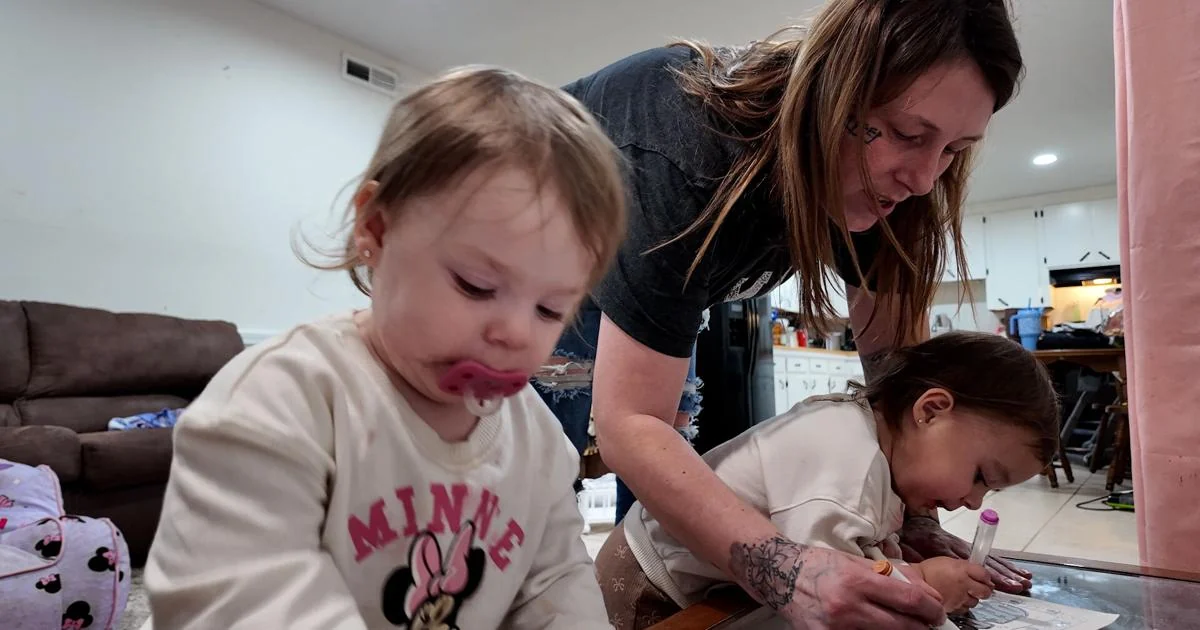
Kathy Briggs spent years cycling in and out of incarceration, battling addiction and questioning whether she would ever become the mother she had always hoped to be.
Briggs spent nearly a year in Missouri’s first prison nursery program at the Women’s Eastern Reception, Diagnostic and Correctional Center in Vandalia before her release in January 2026.
Today, she is raising twin daughters, preparing for marriage, and expecting another child.
It is a life she once doubted would ever be within her reach.
“It means the world to be sober, and to be like a family, and to have a family,” Briggs said. “I didn’t know if that was ever possible for me.”
The program permits eligible incarcerated mothers to reside with their newborns for up to 18 months while receiving parenting education and access to additional support resources.
For Briggs, the program became a meaningful opportunity to break a cycle that had defined much of her life.
Her participation was made possible after a judge dismissed one of her charges , unlawful possession of a firearm.
“If it wasn’t for (Judge) Kevin Selby out of Newton County believing in me and believing that I could do it … I wouldn’t (have been) in the nursery program,” Briggs said.
To be considered for the program, participants cannot have been convicted of a dangerous felony, including sex crimes or crimes against children.
Breaking the cycle
Briggs described growing up in a loving yet dysfunctional household in which both of her parents struggled with addiction.
She performed well academically and participated in sports, but eventually encountered her own challenges with substance use, homelessness, and incarceration.
She learned she was pregnant with twins while evading authorities, and in that moment, she made a decisive resolution.
“I had two miscarriages and I didn’t think I could have kids. And something inside of me just said, if you want to make this (work), if you want to carry this baby, you need to go turn yourself in,” Briggs said. “So three days later, I was sitting in county jail, and it was the best thing I could have done.”
Once she committed to keeping her babies, she was equally committed to becoming the best mother she could be.
“I don’t need anyone to take my kids. I need somebody to help me be a mom,” Briggs recalled telling her mother during a phone call from prison.
Briggs has a “DNR” tattoo , meaning “do not resuscitate” , on the left side of her forehead, which she said she got during a period when she was deeply angry and without hope.
“I had my first miscarriage, and I was really angry at God. He was not a very just God if he was going to let me, a strung-out addict, struggling with addiction, live and take my baby from me,” Briggs said. “I kind of just went on a rampage where I didn’t want to live.”
She described that period of her life as one completely devoid of hope.
“I just wanted to die, so I tattooed DNR on my face,” Briggs said. “If we can’t have our families, what’s the point of living life?”
She is now in the process of having the tattoo removed, saying her children have given her a reason to live.
She named her 19-month-old daughters Lyric and Melody following a conversation with her father, who had jokingly referred to her as his “jailbird.”
“My jailbird (is) going to have jailbirds,” Briggs recalled him saying.
Her response, however, told a different story.
“I was like, No Daddy, I’m not having jailbirds. They’re songbirds. They’re going to be free and they’re going to fly,'” Briggs said. “Whenever a baby starts crying, no matter where you are, you’re going to hear it, and they’re just going to sing.”
More than a prison program
A 2018 study published in The Prison Journal examined two decades of data from Nebraska, which operates the second oldest prison nursery program in the United States. The study found that women who participated in the program were 39 percent less likely to return to prison.
Briggs acknowledged that she struggled with postpartum depression and harbored fears that she would be unable to give both daughters the individual attention they needed following their birth.
She credited nursery program manager Kim Perkins and other staff members with helping her navigate those difficult moments.
“Those ladies picked me up by my bootstrap so many times and just put me on my feet and reminded me like that I can do this,” Briggs said.
Perkins understood some of those challenges from a deeply personal place. A mother of twins herself, she became a single mother after losing her first husband in 2016.
“There were days when I didn’t want to wake up or didn’t want to get out of bed or go to work or do any of those things,” Perkins said.
She noted that those experiences imparted important lessons about perseverance , lessons she now shares with the incarcerated mothers in her care.
“Miss Briggs had no intention of keeping her babies when she found out she was pregnant. She did not want to give birth while she was incarcerated,” Perkins said.
Perkins added that her own experience as a mother of twins, alongside the unit’s functional manager at the time , who was also a mother of twins , uniquely positioned her to support Briggs through that journey.
“I know that if this program didn’t exist, that life, that family wouldn’t exist,” Perkins said.
Briggs said the most significant lesson she took from her conversations with Perkins was the importance of focusing on what she could control.
“Me, myself, my reaction, my words,” Briggs said, recalling those discussions. “But other than that, if it’s beyond my control, it’s not for me to deal with.”
Perkins said witnessing Briggs build a new life for herself has been among the program’s most meaningful outcomes.
“She did not think that she could be a mom,” Perkins said. “And she is an amazing mom because she came through this program.”
Building a family beyond prison
Since her release, Briggs has continued raising Lyric and Melody outside of prison walls.
In August, she met her now-fiancé, Montana Duncan, at church. The following day, the two discovered they worked at the same place.
Both carry histories of incarceration and addiction , experiences Duncan said have deeply influenced how they approach their shared future.
“I love Kathy, and part of loving Kathy is loving Lyric and Melody too,” Duncan said.
Duncan is not the twins’ biological father, but he is the father of the child Briggs is currently expecting.
The couple plans to marry on November 22.
For Duncan, building a family also means confronting the weight of his past. He shared that he previously lost parental rights to his first daughter and is determined not to repeat those mistakes.
“I just want to be a good dad,” Duncan said.
Briggs is fully aware that life outside of prison continues to present its own set of challenges. Nevertheless, she continues to draw on the lessons and relationships she cultivated during her time in the nursery program.
She said she still contacts staff members regularly, even months after her release.
“If it wasn’t for them believing in me, I don’t know that I would have believed in me some days,” Briggs said.