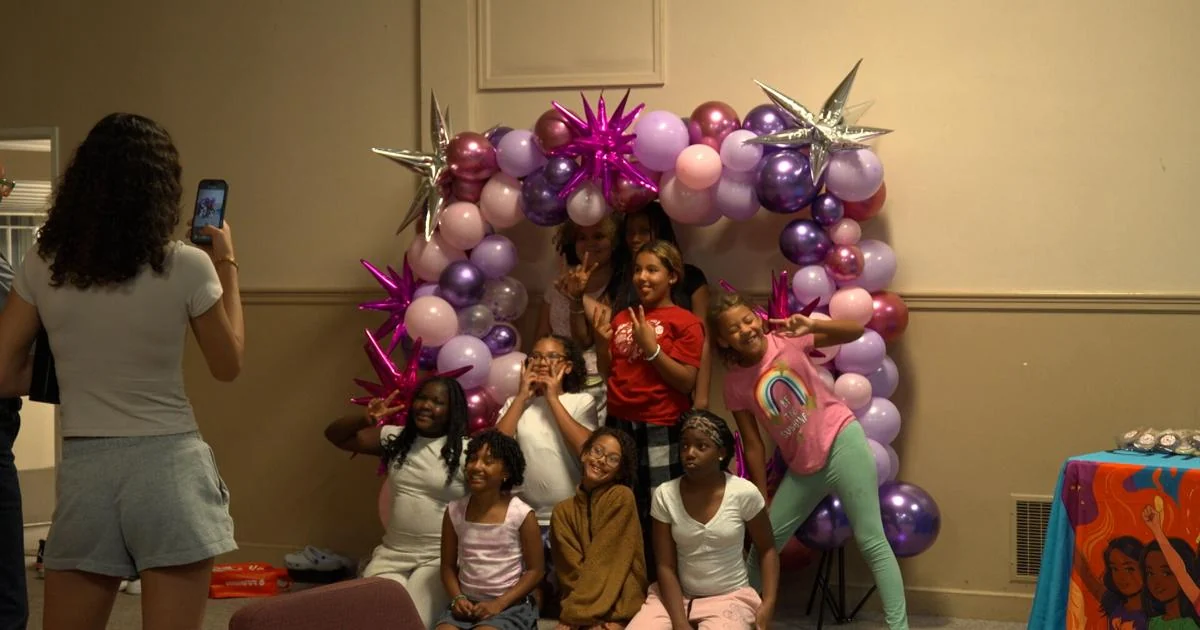
Girls on Fire transcends the conventional definition of an afterschool program for the young girls it serves. It functions as an inclusive, welcoming safe space for all who seek it.
Ruby Woods, a twelve-year-old member of Girls on Fire, describes it as a place where she can connect with peers who share her experience of growing up in Columbia.
“We all understand each other,” Ruby said.
She characterized Girls on Fire as “amazing … because there’s a lot of people that are nice to you and that loves on you a lot and that’s always there for you.”
That very environment was the vision of founder Jessica Chambers. The bonds she and the other 17 girls in the program have cultivated together have created a genuine sense of belonging.
“Oh, it’s amazing. She’s so nice,” Ruby said. “She’s like my mom now. She feeds me. She takes care of me. She’s always there for me.”
Chambers shared that her own upbringing as a young bi-racial girl in Columbia, marked by family challenges including parental addiction, incarceration, and time in foster care, motivated her to provide support to girls navigating similar circumstances.
“Every single one of them has something going on that I had going on as a child, and I want to be here to support them and help them through those things, because I didn’t have that support,” Chambers said.
Chambers recalled experiencing significant trauma as one of the few mixed-race children in a predominantly white community. She is determined to offer these girls something she never had growing up , a steadfast advocate in their corner.
“A lot of these girls in this program look like me, you know, they remind me of me,” Chambers said. “They’re going through things that I went through. I make them feel comfortable, and I make them feel at home and welcome, and they know that they have somebody else that they can turn to and talk to about things.”
She noted that these shared experiences allow the girls to open up to her and help establish trust with their families as well.
“Their parents talk to me; I am a relatable person,” Chambers said. “I look like (some of) their parents as well, and I make them feel comfortable, and I make them feel at home and welcome, and they know that they have somebody else that they can turn to and talk to about things.”
On September 1st, the very day the program launched, Chambers was awarded a $50,000 grant from the Missouri Foundation for Health , funding specifically designated to improve the mental health and overall well-being of Black youth across Missouri. For more than three months, the program has operated Monday through Thursday at Memorial Baptist Church, serving 17 young girls throughout the Columbia area.
“I have been putting in grants all year long,” she said. “I almost had a stroke because I have been worrying, and worrying, and worrying.”
Prior to receiving the grant, Chambers had been personally funding the program out of her own resources.
“Mostly everything that I have done here has come out of my own pocket,” she said. “I paid for it because I believed in what it was all about, and I knew it would be a wonderful thing if I could just get it going.”
An important role in the community
Researchers refer to adults like Chambers as “credible messengers” or “natural mentors” , trusted individuals who offer support, guidance, and encouragement to young people.
Donte Bernard, a clinical psychologist whose work examines the intersection of racism and identity, also focuses his research on promoting wellness within historically marginalized communities. He emphasizes the significance of programs like Girls on Fire, Magnificent Melanin Misses, and the PEACE and HOPE Center in Columbia for Black youth.
“Lived experience often serves the motivation for trying to help folks not have to go through the same path that you went through,” Bernard said. “Especially in a place that may not be as diverse as other areas.”
Bernard further noted that young Black girls have historically been subjected to hyper-sexualization and the exoticization of their identities.
“Having places and programs that can help dispel those myths can also help shape how youth see themselves as well,” Bernard said. “I’m around a group of folks who look like me, who don’t ascribe to what culture has said this is what we should do or shouldn’t do.”
Research supports the value of such mentorship. In a study of 541 academically at-risk Black adolescents, participants who had natural mentors went on to attain higher levels of education and professional training. A separate study of 663 Black adolescents revealed that the stronger a student’s connection to their natural mentor, the greater their academic effort and intellectual curiosity.
“We are underrepresented in the schools, (and) just underrepresented in the community, period,” said Lashunda Glasgow, founder of Magnificent Melanin Misses, a community organization dedicated to creating spaces where young girls can see themselves reflected in those who support them. “So for them to come and be able to talk to people that look like them, that can relate to them, it means a lot to them.”
Finding their voices
Chambers consistently reinforces to the girls that their potential is boundless and that life’s experiences carry meaningful lessons.
“A lot of people teach us what we need to learn so when we grow up we know, like, our decisions, so that we don’t make bad choices,” said Zahara Ciers-Johnson, one of the Girls on Fire members.
Every Wednesday, Chambers invites professionals from a diverse range of backgrounds and fields to speak at the church. Among those speakers is local barber Isabelle Dominique, who has built her career in a male-dominated industry and earned respect through perseverance. She now channels those hard-won lessons into encouraging the next generation.
“Being in a male-dominant field, I’m not always looked at with respect. I have to work my way to get that respect. So coming in here and being able to talk to the girls and be unapologetically myself, they took to that so wonderfully,” Dominique said.
For Dominique, sharing her journey holds particular importance for young girls who rarely see themselves represented in the spaces they inhabit.
“I feel like there’s always something to empower women in general, but never something to empower the community of brown girls … giving a community program to help bring girls together, to empower each other, to find a way to be strong women on their own, I think that that’s something any community should have,” Dominique said.
Representation, however, is only one dimension of what Girls on Fire offers. The program also provides its members with meaningful opportunities to develop their own voices and share their own stories. Through a partnership with local organization FREEAIR Books, the girls are discovering that their perspectives deserve to be heard , and learning how to become published authors in the process.
“We basically help young writers become published authors at no cost to their families,” FREEAIR Books founder George Norman said. “We’re trying to do an anthology for this group of girls by, trusting in young people’s voices and just letting them know that their voices do have value, they carry weight.”
The program also maintains connections with community organizations such as Magnificent Melanin Misses, and that support extends well beyond career development and representation. Through Girls on Fire survival kits, members are also being equipped with the tools to recognize and tend to their own mental health.
“It’s OK to cry. It’s OK to lean on people. It’s OK to question. It’s OK to feel sad,” Glasgow said. “Just know, it’s OK to be flexible. You’re going to have good days; you’re going to have bad days. But also don’t always focus on your bad days. … Enjoy the sweet moments in your life. You have the right to joy and happiness.”
Chambers remains hopeful that Girls on Fire will continue to inspire Columbia’s youth to pursue ambitious dreams, with aspirations to expand the program well beyond its current reach.
“I do hope that Girls on Fire can grow into its own organization and maybe even expand across Missouri, not just in, you know, smaller towns, but Kansas City to St. Louis,” she said. “Let’s grow this thing out, let’s figure it out now.”
To further support the program’s growth, Chambers has established a GoFundMe campaign. She envisions taking the girls on field trips across the Midwest to broaden their horizons and expose them to new possibilities.