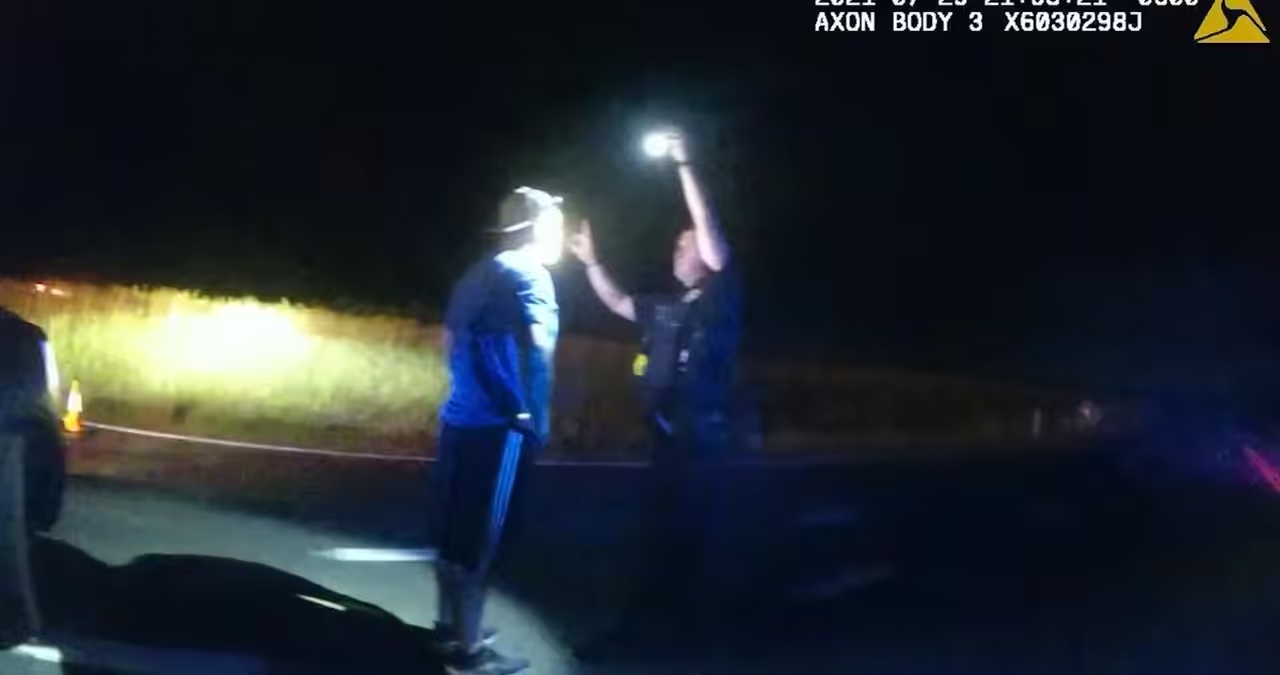
A Nebraska man who stopped to help victims of a devastating motorcycle crash instead found himself handcuffed, jailed and accused of driving under the influence , despite repeatedly asking officers to administer a breath test that he believed would prove his innocence.
Nearly five years later, the City of Fort Collins has paid Jesse Cunningham $500,000 to settle his lawsuit. Cunningham’s attorney says it is the largest settlement ever reached in a wrongful DUI arrest case, though no national database tracks such settlements. As part of the agreement, the city does not admit wrongdoing.
Fort Collins Police Chief Jeff Swoboda said Monday, “..we chose to resolve this one (lawsuit) initiated by Cunningham to avoid the continued expense and disruption of ongoing litigation. The agreed-upon financial settlement is not an admission of liability or wrongdoing by the City and Police Services.”
The settlement stems from Cunningham’s arrest following a serious motorcycle crash in Fort Collins in July 2021.
From first aid to DUI suspect
According to police body camera video, investigative reports and court records, Cunningham, who has medical training, rushed to assist the injured riders while he, his wife and their daughters were wrapping up a Colorado vacation. Cunningham provided first aid that he says helped save the life of one of the injured motorcyclists.
But as emergency responders secured the crash scene, attention shifted from the victims to Cunningham.
Fort Collins Police Officer Jason Haferman reported smelling alcohol on Cunningham. Cunningham told the officer he had consumed two beers several hours earlier.
Within minutes, Cunningham went from good Samaritan to DUI suspect.
“Just the audacity of how I felt the situation had turned. I was in shock. I couldn’t believe what was going on,” Cunningham said.
Repeated requests for a breath test
Body camera video shows Cunningham repeatedly asking Officer Haferman to administer a breath test.
“Can we do a breath test?” he asks.
Cunningham maintained that a breath test would quickly demonstrate he was not impaired.
Later, after the DUI investigation continued, Cunningham again questioned why he was not being allowed to take one.
“So even if I pass a Breathalyzer I still get charged?” he asked Haferman.
Instead, Haferman required Cunningham to perform roadside sobriety tests, which the officer concluded Cunningham failed.
The breath test Cunningham repeatedly requested was never administered.
Haferman arrested Cunningham on suspicion of DUI. Because Cunningham’s minor daughters were in the vehicle, he was also arrested on suspicion of child abuse.
Haferman said he did not allow Cunningham to take a breath test because the Nebraska resident had a prescription for Adderall. Haferman expressed concern that Adderall could affect the breath test.
Cunningham had told the officer that he had not taken any Adderall recently because he had not brought the medication with him on vacation. He eventually took a blood test.
Charges dismissed after laboratory results
The consequences of the case extended well beyond the arrest.
Cunningham said the arrest cost him a possible promotion at work. Child Protective Services opened an investigation into the child abuse allegation, visiting his home in Nebraska, interviewing his daughters, contacting their physician and requiring him to submit to regular urinalysis testing while the criminal case was pending.
Three months later, laboratory testing was complete.
According to test records from the Colorado Bureau of Investigation, blood tests from Cunningham showed no alcohol or drugs. Prosecutors dismissed the criminal case.
“Now I can with 100% surety say that I was innocent that evening,” said Cunningham.
Although the criminal case ended, Cunningham said he could not simply move on.
He filed a federal lawsuit against Officer Haferman and the City of Fort Collins, alleging that he was wrongfully arrested despite repeatedly requesting a breath test and despite laboratory evidence ultimately establishing that he had neither alcohol nor drugs in his system.
“There’s certain things in life and certain things that I know you have to draw a line in the sand, and I need to stand up and do what’s right. This is one of those line-in-the-sand moments,” said Cunningham.
A lasting impact
Cunningham’s background made the experience particularly jarring. He served two combat tours in Iraq as a military police officer, later worked for the Federal Protective Service and now leads a nonprofit honoring members of the military and first responders, including police officers.
Despite that background, he said the arrest permanently changed his perception of law enforcement.
“It just made me extremely cautious. I shouldn’t feel uneasy when law enforcement is around. Unfortunately, now I do.”
Cunningham said no financial settlement can undo what his family endured.
“It was me standing up for myself and defending myself against what I felt was extreme injustice.”
Questions about DUI enforcement
The Cunningham case was not the first DUI arrest by Officer Haferman that later unraveled after laboratory testing.
A previous investigation documented nine DUI arrests in a single year in which people arrested by Haferman were later found through laboratory testing to have no alcohol or drugs in their systems.
Haferman resigned from Fort Collins Police Services in 2022, one day before Police Chief Jeff Swoboda planned to terminate his employment.
Colorado law allows officers investigating impaired driving to request chemical testing after an arrest. Officers also commonly use preliminary roadside breath tests during DUI investigations, although those tests are generally considered investigative tools rather than evidentiary tests. Whether to administer a roadside breath test rests with the investigating officer under the circumstances of the stop.
Cunningham’s lawyer, Sarah Schielke, was asked what she hoped other law enforcement agencies learned from this case and the settlement.
“If you as a police agency say the more DUI arrests you make the better you’re doing at your job, then officers are going to have incentives to arrest innocent people,” said Schielke.
She questioned the police chief’s explanation for settling the case for $500,000.
“Cities don’t pay half a million dollars to settle a case when they believe they made a good DUI arrest,” observed Schielke.
Colorado state records show Haferman is no longer certified as a peace officer in the state. Cunningham said he still respects law enforcement as a whole. But he added, “There’s no sense of justice when you’ve been victimized, no amount of money is going to make up for what my family went through.”