On Tuesday, Senate Republicans expressed notable skepticism following a closed-door briefing in which Transportation Secretary Sean Duffy made his case for a substantial increase in federal funding for the Federal Aviation Administration. His appeal came in the wake of a telecommunications outage that triggered a rare nationwide ground stop the previous Friday, during which overloaded routers forced the FAA to halt air traffic, resulting in thousands of canceled flights and stranded passengers across the country.
Duffy is requesting $50 billion to comprehensively overhaul the FAA’s aging infrastructure, portions of which continue to depend on technology that is several decades old. While lawmakers broadly acknowledged the severity of the problem, Republican senators raised pointed questions regarding both the scale of the funding request and the legislative pathway through which it could realistically be approved.
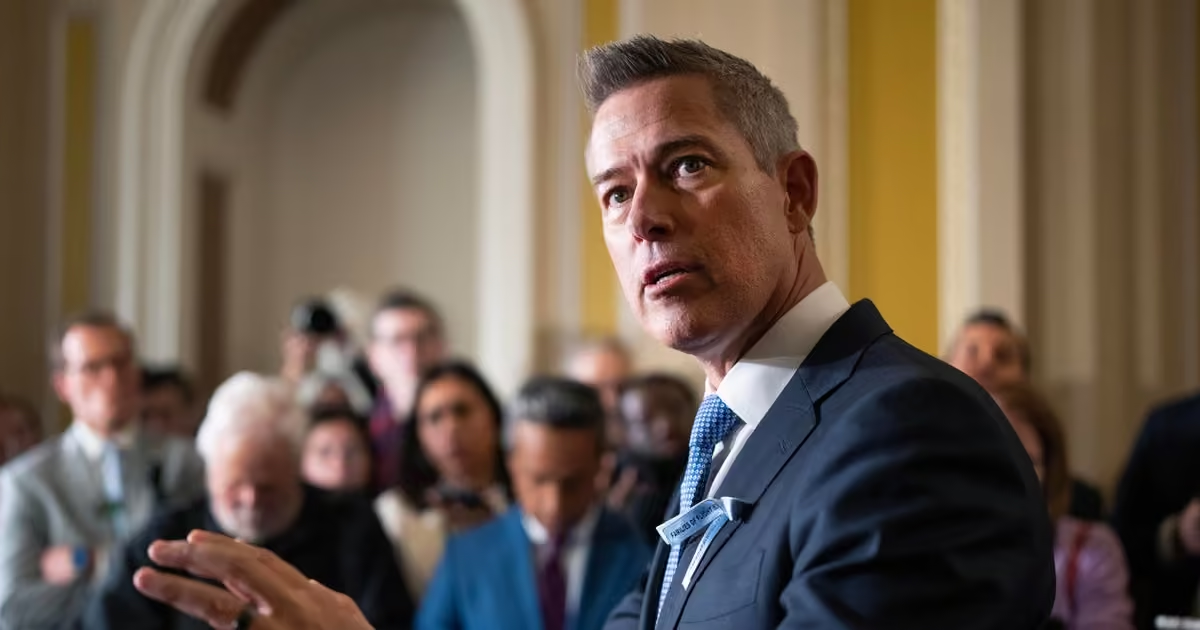
Speaking to reporters following a closed-door lunch with Duffy, Senate Majority Leader John Thune noted that the secretary had fielded a considerable number of questions concerning the proposed funding and its intended allocation.
“How we deal with that issue remains to be seen,” Thune said. “There are ways in which we could do it with Republicans only, there are also ways in which we could do it with Democrats.”
Senate Republicans have been deliberating over the possibility of pursuing an additional reconciliation bill, a legislative mechanism that would allow them to advance the measure without Democratic support. However, the process is both procedurally complex and time-intensive. Thune confirmed that internal discussions would continue into Wednesday, while candidly acknowledging that “the clock is ticking” as the current congressional session draws closer to its end.
It is worth noting that Congress had already allocated $12.5 billion for the FAA through the One Big Beautiful Bill Act the previous year. Duffy indicated that the majority of those funds had already been designated for various projects. Thune referenced this prior allocation while conceding that further action was necessary.
“We did that then , there’s more that’s required,” Thune said. “How that gets done is still an open question.”
Thune further suggested that several senators harbor reservations about the $50 billion figure specifically. He noted that the administration’s original request, prior to the ground stop, had stood at $30 billion, and that even that figure encompassed not only immediate infrastructure needs but also a range of broader objectives. He argued that some of those initiatives would be more appropriately funded through standard government appropriations rather than through reconciliation.
When asked to explain the $20 billion increase, Duffy told CBS News that he had made a deliberate decision to present the full scope of what was needed.
“There’s been a historic underinvestment in aviation,” Duffy said. “I hope we get the full investment.”
Senator John Kennedy of Louisiana was particularly direct in expressing his frustration with the revised figure, telling reporters he was “furious when they went from $30 billion to $50 billion.”
“I mean, I’m not Bambi’s baby brother,” Kennedy said.
Senator Rick Scott of Florida took to social media to thank Duffy for his efforts while simultaneously advocating for a more modest investment.
“We absolutely need to update our air traffic control system, which would cost about $10 billion,” Scott wrote, while stressing that “the airlines need to put up money and have skin in this game too.”
Not all Republican senators shared those reservations, however. Senator Eric Schmitt of Missouri, who has been actively collaborating with the administration on proposed aviation infrastructure funding, told reporters that the technological needs facing the FAA are both extensive and urgent.
“So my position is: Let’s go fix this on behalf of the American people,” he said. “They saw what happened. I think they would want us to be responsive to that.”
Schmitt expressed support for advancing the funding through the reconciliation process, stating that while he had no desire to make the issue partisan, he believed some of his Democratic colleagues were approaching it differently.
“I was advocating for this before Friday, and then what we saw Friday, I just think this is something that we should do,” Schmitt said. “I can’t think of anything more important than the safety of the millions of Americans that fly.”
Following the meeting, Duffy characterized the engagement from Republican senators as “fantastic,” and expressed confidence that the party would work through the appropriate funding levels and approach to adequately address the needs of the nation’s airspace.
In outlining his request, Duffy emphasized the need for a modern, resilient national network, as well as broader investment in physical infrastructure such as air traffic control towers, new runways, and airport facilities. When asked whether he would accept a more incremental approach to funding, Duffy indicated he would take what he could secure, but warned that without meaningful change, the pace of progress would be wholly inadequate.
“So we have to do something different,” Duffy said.