
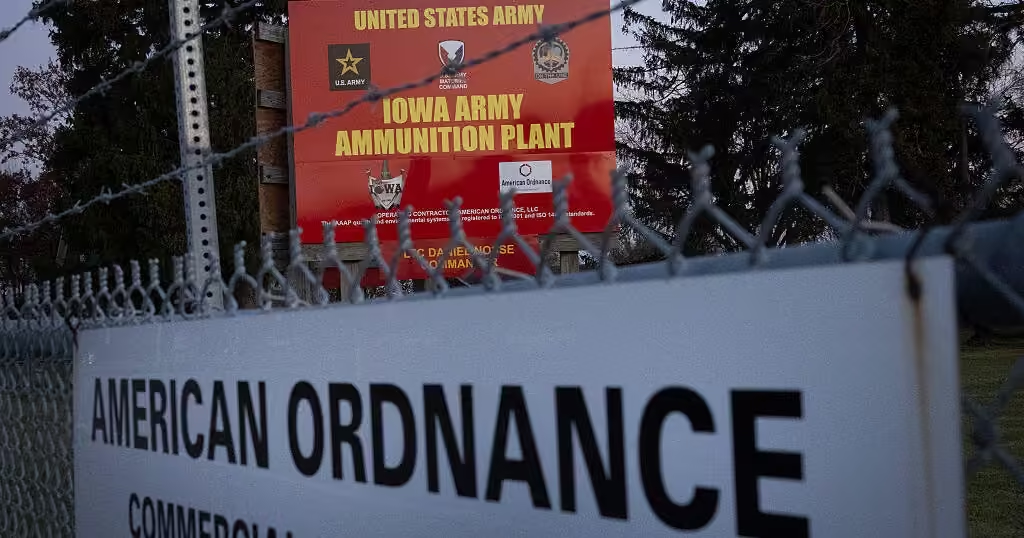
The U.S. Army has announced its intention to proceed with the detonation of several tons of unstable explosives at a munitions plant in Iowa on or before Tuesday, according to a recently filed court document. This decision comes despite a federal court order that indefinitely suspended the detonation plans. The Army has stated that it is not obligated to comply with the court order, citing the public safety risks associated with the possibility of the explosives detonating spontaneously.
In federal court records submitted late Saturday, the Department of the Army indicated its intent to invoke an emergency munitions and explosives exclusion to the Environmental Protection Agency’s permit. The government contends that a controlled detonation is necessary to protect the public from the considerably greater threat posed by an uncontrolled explosion.
On Friday, a federal court suspended the Army’s plan to detonate explosives containing lead azide at a munitions plant in Middletown, Iowa, following significant community concern regarding the potential spread of toxic lead particles in a dust plume across portions of Iowa and Illinois. The Army had originally scheduled two controlled explosions for Friday before postponing them to Monday, at which point the court intervened.
The 8th U.S. Circuit Court of Appeals granted an emergency motion to halt the demolition after environmental groups initiated a lawsuit.
The military stated on Friday that it was collaborating closely with the Department of Health and Human Services and the EPA to ensure the controlled explosion would be conducted in the safest manner possible.
“Officials have been meticulously planning for this event since March, and all agencies involved are prepared to take the most extreme mitigation measures available to ensure there is no risk to the public and any disruptions are minimized,” the statement read.
In its Saturday filing, the government cautioned that the controlled explosion must be carried out by Tuesday, as temperatures are expected to fall below 30 degrees Fahrenheit within the coming days. The Army noted that the lead azide has deteriorated and that crystals within the waste material could fracture as temperatures decline.
“A controlled detonation allows the Army to implement measures to minimize the risk to the public, including the risk from the ejection of partial unexploded ordnances that can explode later from the Facility,” the court filing states. “The Army intends to act consistent with the terms of the Emergency Permit and its mitigation measures even if not in effect. That includes mitigation measures to minimize the risk of the dispersal of lead dust. In short, a controlled detonation is by far safer than an uncontrolled explosion.”
In response to the Army’s filing, the Iowa Environmental Council and the Sierra Club submitted a motion on Sunday seeking to supplement their emergency request to block the planned detonation. The filing includes declarations from three experts and local government officials challenging the Army’s assessment of the risks associated with delaying the detonation, along with concerns regarding public notification and potential health and environmental consequences.
In March of this year, the Army disclosed that 68 drums of lead azide stored at the site had begun undergoing “recrystallization.” The lead was housed in bunkers at the Iowa Army Ammunition Plant, a munitions facility established in 1941 that produces medium- and large-caliber munitions.