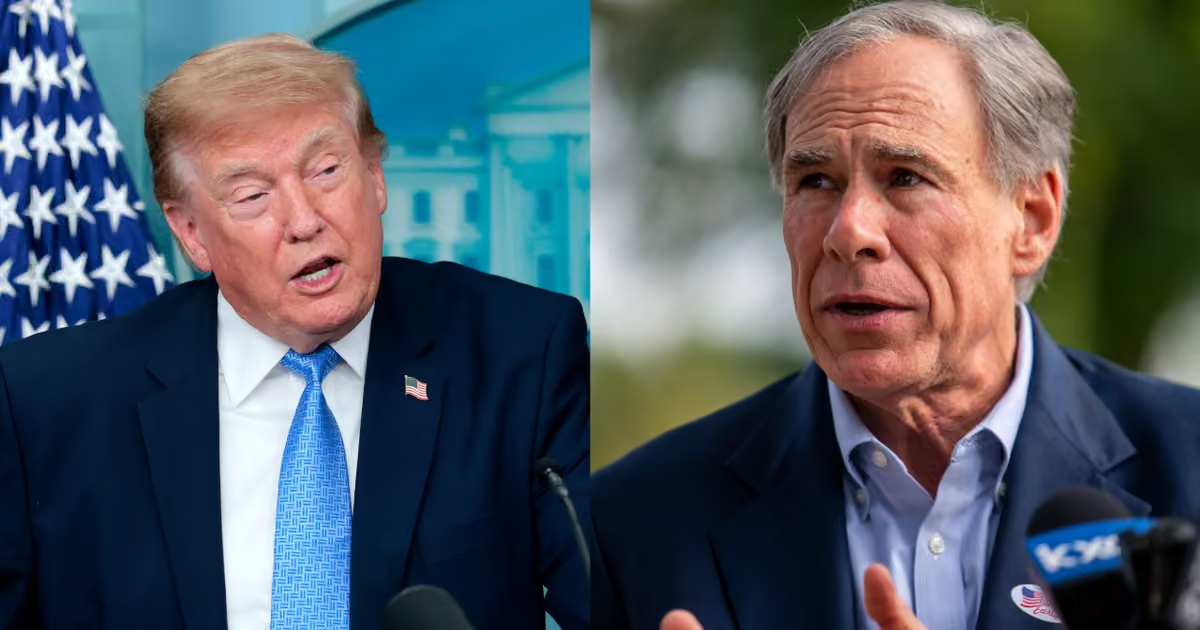
President Trump pressured Governor Greg Abbott to secure five additional Congressional seats in Texas at the Democrats’ expense. However, it was the Democrats who ultimately benefited, as a blue wave swept across the Lone Star State.
At the start of the year, Republicans held 25 Congressional districts while Democrats controlled 13. Heading into the midterm elections, Republicans had anticipated holding 30 seats, which would have reduced Democrats to just eight. The outcome, however, told a different story , Republicans finished with 24 districts, while Democrats expanded their hold to 14 seats.
The White House had pursued this effort after 13 of 16 counties along the southern border shifted red and voted for President Trump two years prior. The redistricting push that originated in Texas sparked a nationwide controversy as other states subsequently redrew their own Congressional district boundaries.
There was, however, one notable success for Republicans: the newly drawn 32nd Congressional District in North Texas, where Republican Jace Yarbrough defeated Democrat Dan Barrios. Republicans had redrawn this district to shift it from a Democratic to a Republican majority. It encompasses portions of Dallas and Collin counties and extends into five additional counties to the east.
Yarbrough lost in both Dallas and Collin counties but secured victories in the remaining counties. He also trailed in early voting by 3,489 votes, yet recovered to win on Election Day by a margin of 8,053 votes. Prior to the election, the Cook Political Report, which evaluates political races across the nation, had classified this district as “Solid R.”
In an interview with CBS News Texas, U.S. Representative-elect Jace Yarbrough stated that he and his campaign took nothing for granted. “While there were several people who were telling us not to worry, we put together a great team who did a great job to get out in front of what a lot of people didn’t see coming, to make sure that we started working extra hard, eight weeks out from the campaign, which is what we did,” said Yarbrough. “In terms of this being a solidly red seat, I think across the state of Texas, you saw a number of congressional districts that voted for James Talarico, but the Republican nominee for Congress. That’s not a bluing up of Texas in my mind. That’s frustrated Republicans who are coming out to vote.”
Yarbrough’s victory was achieved despite the formidable political headwinds confronting Republicans across the country, including elevated food, gasoline, and diesel prices.
He attributed his success to remaining attentive to the concerns of his constituents. “It’s always imperative to prioritize the things you’re hearing from the voters in your district. You have to take them seriously. They’re the ones communicating with you what they’re feeling on the ground, and what it feels like to live and work in America in 2026. That’s what we did in this campaign, and I have no intention of letting up on that at all. We’re going to go out and continue to earn votes and support. Our government and our economy should all be in service to them.”
While Yarbrough stood as the only newly elected Republican Congressional candidate to win in Texas, the GOP had redrawn four additional seats with the intention of flipping them. Among these was the newly configured 9th Congressional District in the Houston area, which Democrats managed to retain when Leticia Gutierrez defeated Republican Alex Mealer by nearly 26,000 votes , despite the Cook Political Report having identified Mealer as the frontrunner. The remaining contested seats were located in South Texas and along the border region.
One such district was the 28th Congressional District in Laredo, where Democratic incumbent Henry Cuellar comfortably secured re-election over Republican Tano Tijerina by more than 62,000 votes. In the 34th Congressional District in South Texas, Democratic incumbent Vicente Gonzalez similarly retained his seat, defeating Republican Eric Flores by more than 32,000 votes. In the newly drawn 35th Congressional District near San Antonio , an open seat , Democrat Johnny Garcia defeated Republican Carlos De La Cruz by more than 27,000 votes.
The final tally across these five districts was unambiguous: Republicans gained one, while Democrats won the remaining four. The GOP had also anticipated holding two additional seats. One of these was the 15th Congressional District in South Texas, where incumbent Monica De La Cruz lost to Democrat Bobby Pulido, the well-known Tejano singer, by nearly 50,000 votes.
The 23rd Congressional District, stretching from the El Paso area to San Antonio and designated as an open seat, also flipped to the Democrats , despite having been drawn with a Republican majority in mind. Katy Padilla Stout defeated Republican Brandon Herrera by more than 22,000 votes.
Joshua Blank, Research Director at the Texas Politics Project at the University of Texas at Austin, indicated that the growing influence of Hispanic voters played a pivotal role in the Republicans’ redistricting setback. “We knew going back to the 2024 election that Hispanic voters in Texas said the economy was their number one issue. They said that they trusted Donald Trump more than Kamala Harris to handle the economy, and they put him back in the office with his own promise that he was going to address inflation on day one. Ultimately, he instituted tariffs, he started a war that’s increased gas prices, and those Hispanics swung way, way back in Democrats’ favor. The consequence of that was all these districts that were drawn, assuming that Hispanics were a 50-50 or a 54-45 Republican group, are not Republican districts when those Hispanics vote 60-40, 65-35, 70-30 for the Democrats.”
All incumbent Republican members of Congress in North Texas won re-election. Nevertheless, they may face considerable challenges in the future, as they lost ground within the portions of their districts located in Dallas, Tarrant, and Collin counties , even though those districts remain Republican-majority. The affected representatives include U.S. Representatives Keith Self in the 3rd Congressional District, Pat Fallon in the 4th Congressional District, Lance Gooden in the 5th Congressional District, Jake Ellzey in the 6th Congressional District, Craig Goldman in the 12th Congressional District, and Roger Williams in the 25th Congressional District.
Blank noted that these districts are undergoing significant transformation. “What you notice when you look at places like Collin County, and you look at the various different communities within Tarrant County, you’re looking at high-growth areas. You’re looking at areas that don’t look the same as they looked 10 or 15 years ago. That’s not because people are leaving the cities to move out there, it’s because people are coming towards the cities. When you’re looking at the groups that are really driving this population growth, you’re talking about young Texans. When you’re talking about younger Texans, you’re talking about a very diverse group of people.”
Blank further observed that these demographic shifts are rendering suburban areas increasingly competitive from a political standpoint. “We already knew that the suburbs of Texas were really where most of the political competition was taking place, but what we’re seeing at this point is the manifestation of that competition. These areas, I don’t think we should expect them to get any less competitive than they are, but that also means that the state of Texas is going to be a little different looking, no matter what, going forward.”
Beyond Yarbrough, North Texas will welcome two additional new members of Congress beginning in January. In the 30th Congressional District, Democrat and Pastor Frederick Haynes III will succeed Congresswoman Jasmine Crockett in this Democratic-majority seat. Former Democratic Congressman Colin Allred is also returning to Capitol Hill and will represent the newly drawn 33rd Congressional District, now confined entirely to Dallas County and likewise a Democratic-majority seat.
In the aftermath of last year’s redistricting dispute, several Democratic state lawmakers are seeking to reform the process by which Congressional and state House and Senate districts are drawn in Texas. Currently, the responsibility for drawing these districts rests with state legislators. However, multiple bills introduced by Democrats would establish an independent redistricting commission to handle the drawing of all Congressional, State House, and Senate seats in place of elected lawmakers. Implementing such a commission would require an amendment to the Texas Constitution, with voters ultimately having the final say on the matter.
A separate bill also seeks to amend the Texas Constitution to prohibit redistricting from occurring more than once per decade.