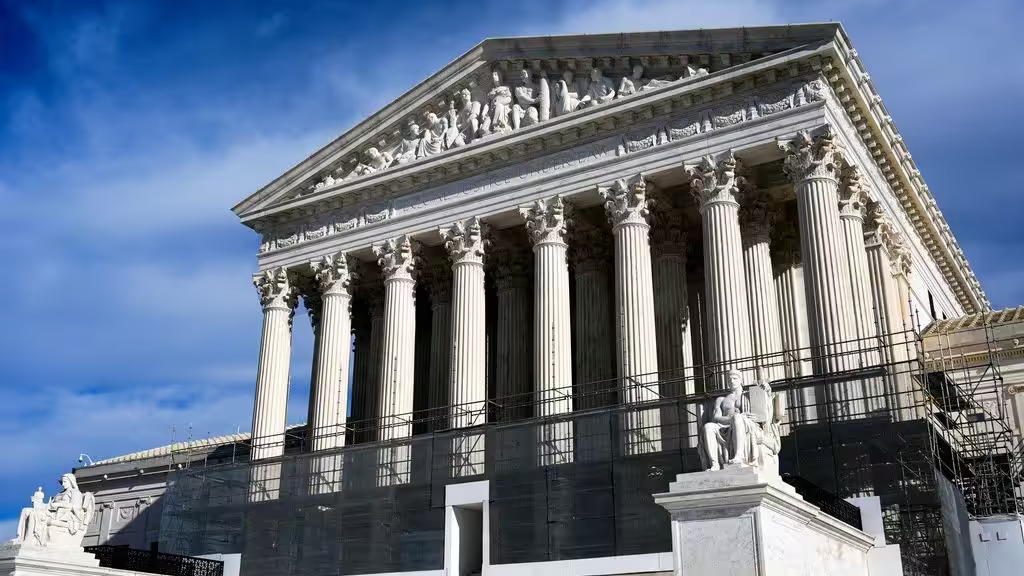
The U.S. Supreme Court on Monday declined to hear a bid by an online citizen journalist seeking to revive her lawsuit, which accused authorities in the Texas city of Laredo of wrongful arrest after she requested and obtained nonpublic case information from police.
The justices rejected Priscilla Villarreal’s appeal of a lower court ruling that found the police officers and prosecutors she accused of retaliation were protected by a legal doctrine known as qualified immunity, shielding them from being sued for allegedly violating her free speech rights under the U.S. Constitution’s First Amendment.
By doing so, the justices allowed the lower court’s ruling to stand.
Qualified immunity serves as a legal defense that can protect government officials from liability in lawsuits over their actions. Villarreal had asked the Supreme Court to determine that qualified immunity should not apply to public officials who use a state statute in a way that clearly violates the First Amendment, as she argued occurred when police arrested her.
Liberal Justice Sonia Sotomayor dissented from the court’s decision not to hear Villarreal’s appeal. Sotomayor wrote that by declining the appeal, the Supreme Court “leaves standing a clear attack on the First Amendment’s role in protecting our democracy.”
Sotomayor said Villarreal’s case, which received support from prominent U.S. media outlets and free speech advocates, “implicates one of the most basic journalistic practices of them all: asking sources within the government for information.”
However, Sotomayor noted that under the view expressed by the New Orleans-based 5th U.S. Circuit Court of Appeals when it ruled against Villarreal, “police officers may arrest journalists for core First Amendment activity so long as they can point to a statute that the activity violated and that no high state court had previously invalidated, whether facially or as applied.”
Villarreal’s lawyers at the Foundation for Individual Rights and Expression said in a statement that they were disappointed with Monday’s decision, adding that it “only shines more light on the need for the court to revisit how qualified immunity applies in free speech cases, sooner rather than later.”
Villarreal has built one of Laredo’s most popular news platforms, with more than 200,000 followers on the Facebook page she uses to report regularly on crime, events and government.
Authorities charged her with two felony counts of misuse of information after she posted the identities of suicide and car crash victims on Facebook in 2017, using details she confirmed by speaking with a Laredo police officer.
The Texas statute under which she was charged makes it a crime to solicit nonpublic information from a government official with the intent to obtain a benefit. Prosecutors argued she used the information to grow her Facebook following.
In a 10-5 decision last year, the 5th Circuit ruled that the officers and prosecutors were entitled to qualified immunity and that law enforcement was not required to anticipate whether the Texas law in question was constitutional before making the arrest.
Judge Edith Jones, writing for the court, said it was inappropriate to “portray her as a martyr for the sake of journalism,” adding that Villarreal had bypassed the Texas law “to capitalize on others’ tragedies to propel her reputation and career.”
In asking the Supreme Court to hear the case, Villarreal’s lawyers argued that the 5th Circuit’s ruling “doubled down on granting officials free rein to turn routine news reporting into a felony.”
Her appeal also gained support from the Reporters Committee for Freedom of the Press, while major media outlets such as ABC, the New York Times and the Washington Post urged the Supreme Court to take up Villarreal’s case.