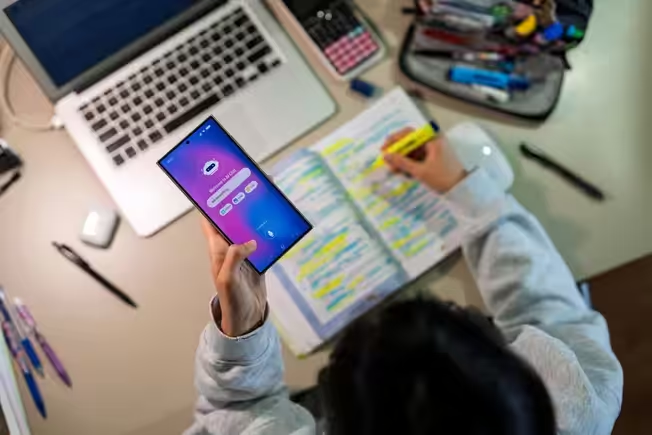
Halfway through my student’s “Beowulf” summary, I stopped.
The high school senior struggled to understand complex texts and often had difficulty with writing. Yet this summary looked flawless: it had no grammatical mistakes, used college-level vocabulary, and included sentences longer than the assignment required. After I asked a few questions, he admitted that he had used a generative artificial intelligence tool.
My students are not the only ones turning to AI. A 2025 Gallup-Walton Family Foundation poll found that 32% of teachers use AI each week, saving an average of six hours weekly on administrative work, customized lesson plans, and feedback.
Standardized tests such as the Arkansas Teaching, Learning, and Assessment System now also rely on AI to grade writing and return scores within 72 hours. This approach effectively introduces AI into every public school classroom across the state, creating high stakes for both students and educators.
Students may gain some advantages from using AI in school. My former student might have benefited if his teachers had used an AI program to generate different versions of lessons designed for a wide range of learners, including those with learning disabilities. He also might have benefited from AI tools like text prediction and talk-to-text, which were not widely available when he was in my classroom.
Our district now provides these powerful tools and others on every student Chromebook. Even with these supports in place, I still worry about AI in schools, and many others share these concerns.
A 2023 Forbes Advisor survey found that 65% of teachers worry about student plagiarism involving AI. English teachers especially struggle to convince students that developing their own writing skills matters when they can generate text instantly with a single click.
Most concerning, a Massachusetts Institute of Technology study suggests that relying too heavily on large AI models can weaken critical thinking and problem-solving abilities over time.
While AI can provide transformative support for students who need it, it also threatens to weaken the fundamental skills we want them to develop. Arkansas needs a balanced strategy that prioritizes accessibility without reducing academic rigor. We must focus on three key areas.
First, teachers, administrators, and parents need strong support and professional development so they understand AI platforms and what they can do. Colleges and graduate programs should include new technology in the training of future educators. They should learn about AI tools that support student learning; programs such as text-to-speech and grammar checkers can greatly assist students with learning disabilities and help teachers provide necessary accommodations for those with 504 plans and Individualized Education Programs. Teachers should also understand which AI functions appear in their subject areas so they can guide students on artificial intelligence and what is permitted in the classroom.
Second, we must teach students about the complexities of AI. Students like mine need to recognize that while AI has become part of everyday life, it can also be unreliable. It may contain false information and bias, and it can create risks for their personal data, privacy, and mental health. I show my students examples of AI programs citing sources that do not exist. Because of this, my students use search tools like Google and online libraries to locate and verify research sources instead of relying on AI to find and cite them.
Finally, schools must establish clear ethical guidelines for AI use. Educators must ensure that students still gain the knowledge and skills required to meet the state’s academic standards. Students should not rely on AI for tasks that involve essential skills they must develop and that teachers like me must accurately evaluate. Schools can allow and encourage tools that support student growth and understanding instead of letting students “outsource” their learning. Teachers may create their own classroom guidelines, or schools can develop shared policies for both educators and students. The Arkansas Department of Education could also provide guidance for teachers and districts that want to create their own AI policies.
When it comes to AI use, Arkansas teachers, administrators, and other stakeholders must find an approach that supports student learning and prepares them for the future. We can help students by giving them the technology they need to succeed in class while also guiding them on appropriate ways to use new tools.
With clear guidelines in place, educators like me can make sure the next generation is ready to enter an AI-driven world and workplace while strengthening their critical thinking skills and preserving their integrity. Our policies must clearly define what responsible, skill-building AI use looks like in schools.