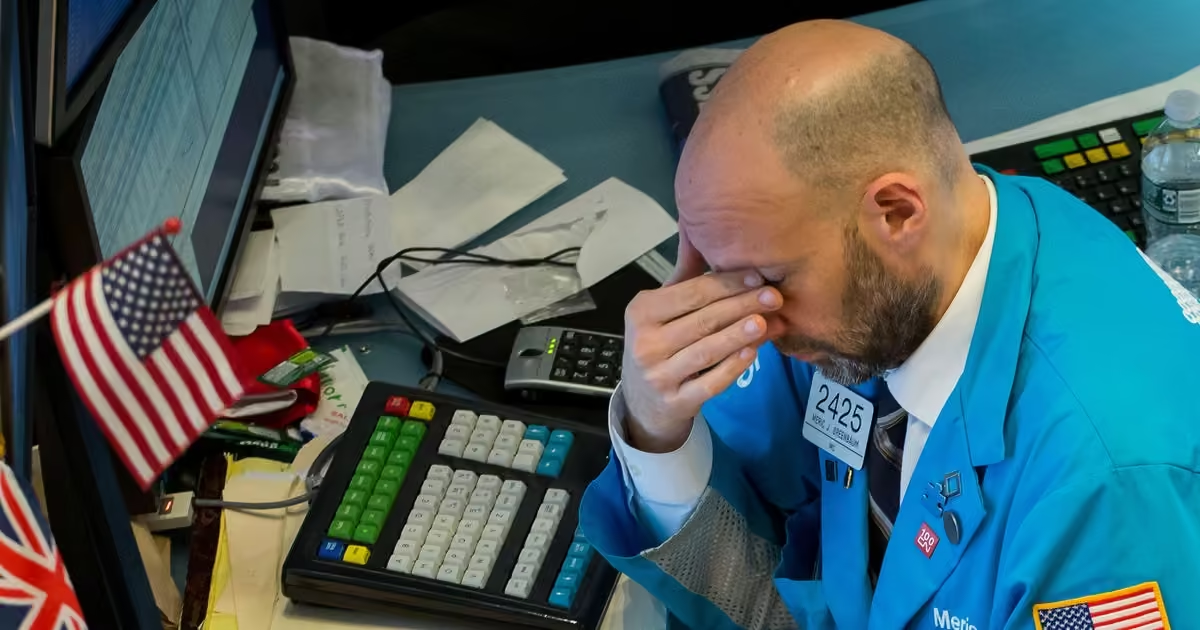
The stock market is experiencing its most turbulent period since the early stages of the pandemic.
Stocks resumed their decline on Friday following a sharp drop the previous day, with the S&P 500 recording a seventh consecutive session of losses. The Nasdaq Composite Index dropped 1,261 points, or 5.3%, closing at 22,618 , marking the index’s second-worst trading day of 2026 and effectively wiping out all of its year-to-date gains. The S&P 500 declined by 3.7%, while the Dow Jones Industrial Average fell 1.9%.
Below are six key factors weighing on investor sentiment, along with guidance from financial experts on how to respond.
Fears that AI investments might not pay off
Investors are growing increasingly concerned that the substantial capital being poured into data centers and the broader infrastructure required to support artificial intelligence may not yield the anticipated returns. Anthropic, the first AI company to go public, has demonstrated impressive revenue growth; however, its regulatory filings also reveal staggering losses , approximately $104 billion during the first nine months of 2026 alone.
“Those figures explain both the frenzy and the nerves,” said Nigel Green, CEO of deVere Group, an investment advisory firm. “From here, the market will judge whether the software layer can turn breathtaking growth into lasting profit, and Friday’s wobble shows the judging has already begun.”
Anti-data center laws could take root
With Democrats poised to gain control of Congress, investors are preparing for potential legislation that could place restrictions on data center construction once newly elected officials assume office in January. While the shifting political landscape is not anticipated to bring the buildout to a complete halt, even a moderate slowdown could meaningfully affect the financial performance of major technology companies that are investing heavily in artificial intelligence.
“The Blue Tidal Wave win and fears about an anti-AI/anti-data center DC” are contributing to the selloff, said Dan Ives, an analyst at Yorkville Ives, in a Friday report.
The Fed raising interest rates
The Federal Reserve is widely expected to raise interest rates at its December meeting, as inflation continues to remain significantly above the central bank’s 2% annual target. While higher interest rates serve to curb inflation, they also increase the cost of borrowing, which in turn dampens consumer spending and constrains business investment.
“The evidence does not suggest we are on a path back to 2%” without intervention from the central bank, Federal Reserve Bank of Chicago President Austan Goolsbee told reporters on Thursday.
A crackdown on chip exports
The disclosure that former Nvidia CEO Jensen Huang had a personal relationship with a Chinese businesswoman believed by U.S. intelligence to be a spy for the People’s Republic of China has intensified calls for tighter export restrictions. The subsequent upheaval at Nvidia, including Huang’s resignation, has prompted the Commerce Department to move forward with measures limiting the sale of advanced AI chips to China.
“The chip industry globally is witnessing a far larger impact from Washington’s new export restrictions than initially expected,” said Adam Crisafulli, an analyst at Vital Knowledge, in a research report.
Fears over President Trump’s saber-rattling
Israel and the United States are reportedly considering launching a new military offensive against Iran in the near term, according to sources familiar with the matter who spoke with CBS News. This development has heightened concerns that renewed hostilities could trigger another surge in oil prices, further compounding existing inflationary pressures.
“The Iran war remains in a dangerous liminal stage,” Crisafulli said.
Government shutdown risks
Lawmakers are facing a December 11 deadline to extend funding for the majority of federal agencies and avert a government shutdown. However, there is a real risk that negotiations in Washington could collapse, as a number of congressional Democrats are pushing to block any spending bill that does not include restrictions on funding for the conflict with Iran.
Shutdown risks may also intensify in the coming year under a divided government, according to Oxford Economics. The Democratic-controlled Congress could “bring bruising fights over shutdowns and the debt limit, while doing little to curb tariff, immigration and geopolitical uncertainty,” analysts at the investment advisory firm noted in a report published this week.
What experts advise
Financial professionals emphasize that while staying well-informed is essential, making impulsive decisions to sell stocks out of panic is generally inadvisable, as doing so can result in losses that are difficult to recover. As a point of reference, investors who exited the market in February 2020 may have forfeited the substantial gains that followed as the economy rebounded from the pandemic.
“We have seen so many peaks and valleys over the decades, with many investors asking us over the last few weeks, is this a March 2000 moment (pre-dot.com bubble) or Fall 2007 vibe (financial crisis buildup),” Ives wrote. “This is a painful tech sell-off that is heavily discounting [that] this 4th Industrial Revolution thesis will take place over the next few years, and that is the wrong move in our view.”