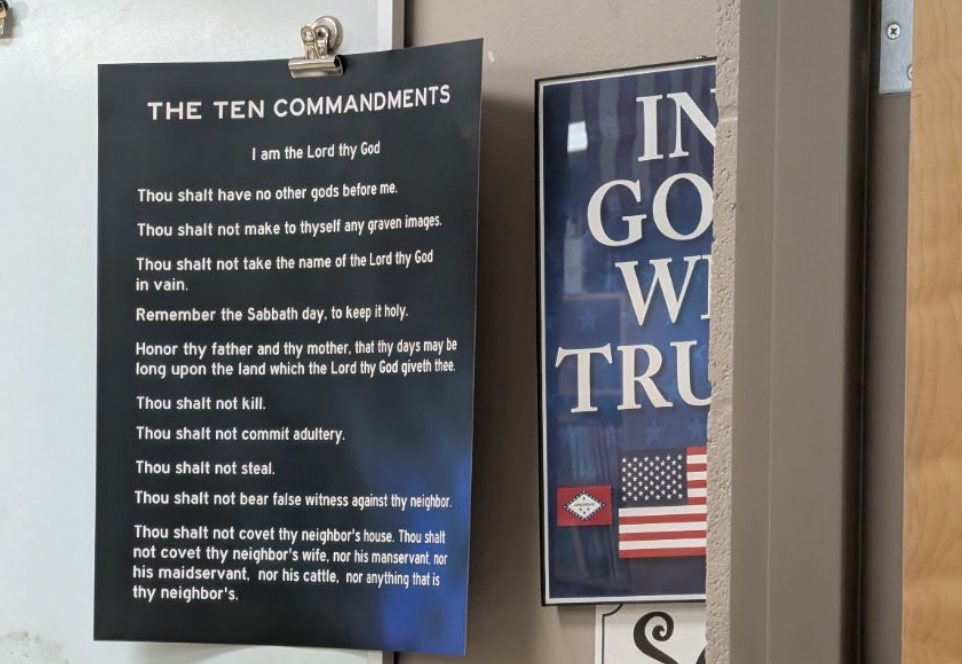
BATON ROUGE, La. — A federal judge struck down an Arkansas law last week that required public school classrooms to prominently display the Ten Commandments, marking one of several legal challenges to state laws that bring religion into public schools.
The Arkansas law closely mirrors measures backed by Republicans, including President Trump. Louisiana and Texas have also passed similar laws mandating the display of the Ten Commandments in classrooms. Each of these requirements has faced legal challenges, and many expect the U.S. Supreme Court to ultimately decide their fate.
Here’s a closer look at where these mandates stand, as they continue to fuel the long-standing debate over the role of religion in government institutions.
Republicans pledge to appeal Arkansas decision
Last year, seven Arkansas families from both religious and nonreligious backgrounds filed a lawsuit challenging the state’s new law that required all public elementary and secondary schools to display the Ten Commandments in every classroom and library. The lawsuit listed six Arkansas school districts as defendants.
While it remains unclear how many school districts or publicly funded universities have put up the displays, local media outlets have pointed to several examples over the past five months. This includes the Ten Commandments being posted at the University of Arkansas on its Fayetteville campus, as the Arkansas Advocate reported in October.
Critics argue the mandate is unconstitutional and breaches the separation of church and state. Supporters of the law maintain that the Ten Commandments carry historical importance and form part of the foundation of the U.S.
U.S. District Court Judge Timothy L. Brooks wrote in his ruling that “nothing could possibly justify hanging the Ten Commandments — with or without historical context — in a calculus, chemistry, French, or woodworking class, to name a few.”
Brooks, who former President Obama nominated, added that there is “no need to strain our minds to imagine a constitutional display mandated” by the 2025 law: “One doesn’t exist,” he wrote.
Although Brooks’ ruling blocks the requirement, it remains unclear how broadly it applies — whether it is limited to the specific school districts named in the lawsuit or extends across the entire state. Megan Bailey, a spokesperson for the American Civil Liberties Union of Arkansas, one of the groups representing the parents challenging the law, said the ruling “makes clear the law is unconstitutional.”
Gov. Sarah Huckabee Sanders said in a statement that she plans to appeal the decision and “defend our state’s values.”
Louisiana schools urged to put up posters
In 2024, Louisiana became the first state to require poster-sized displays of the Ten Commandments in every public school classroom, from kindergarten through college.
Even as the legal challenge has moved through federal courts for nearly two years, a ruling last month vacated an earlier court order that had blocked the law from taking effect — allowing displays to be installed in classrooms.
Immediately following the Feb. 20 decision by the full U.S. 5th Circuit Court of Appeals, Gov. Jeff Landry directed schools to comply with the law and post the Ten Commandments.
The law requires schools to accept donated Ten Commandments posters, which must feature “large, easily readable font.” Earlier this year, a conservative advocacy group, Louisiana Family Forum, distributed posters to most of the state’s parish school systems, the New Orleans Advocate/the Times-Picayune reported.
So far, there have not been widespread reports of schools putting up the posters, as some school officials have raised concerns about possible litigation. However, others say the displays are expected soon.
Posters appear in Texas classrooms
Last year, a similar mandate in Texas took effect — marking the most expansive effort in the country to display the Ten Commandments in public schools.
Amid strong opinions from teachers, parents, and students, posters began appearing in classrooms as school districts either accepted donations or paid to have them printed. About two dozen of the state’s roughly 1,200 school districts were prevented from displaying the posters after federal judges issued injunctions in lawsuits challenging the law.
In January, the U.S. 5th Circuit Court of Appeals heard arguments regarding the Texas law, and the case remains ongoing.