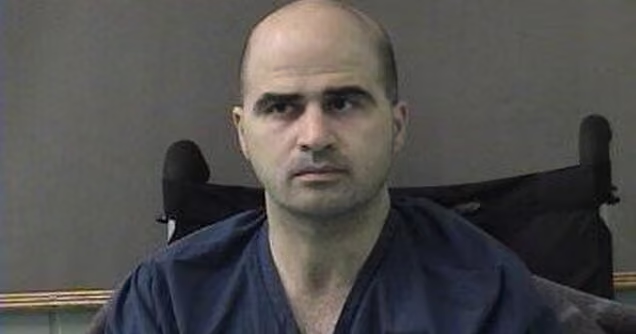
Nidal Hasan, the Army soldier convicted of fatally shooting 13 people during the 2009 attack at a Texas Army post, has informed a federal court of his intention to file a petition seeking a delay of his execution by firing squad.
In the filing, which Hasan signed personally, he states that he “intends to demonstrate that the military court’s judgment and his resulting sentence of death were obtained and are maintained in violation of his federal constitutional and statutory rights.”
According to court documents obtained by CBS News, Hasan, a former military psychiatrist, alleged that his constitutional rights were violated “due to unlawful command influence” by President Trump and Secretary of Defense Pete Hegseth, “who are driven by unlawful racial and religious animus.”
Hasan, who is Muslim and of Palestinian descent, was found guilty on multiple counts of murder and attempted murder in connection with the deaths of 13 individuals and the wounding of more than 30 others in the attack. He acknowledged during trial that he was responsible for the shooting, asserting that he opened fire on fellow soldiers in an effort to protect Islamic insurgents from U.S. military forces. He was a vocal opponent of the U.S. war on terror and characterized it as a “war against Islam.”
Trump-appointed judge to hear the case
Court records indicate that Hasan’s case has been assigned to Judge Tony Mattivi of the U.S. District Court in Kansas, where it was filed given that Hasan is currently held at the military prison at Fort Leavenworth in that state.
A hearing has been scheduled for Wednesday morning, according to court records.
Judge Mattivi was nominated by President Trump and was confirmed by the Senate on June 9.
According to his judicial biography, Mattivi served from 2009 to 2013 as the lead prosecutor in the capital military commission at Naval Station Guantanamo Bay, Cuba, in the case against the al-Qaida operative responsible for masterminding the bombing of the USS Cole.
Asking for a broader definition of victims
Hasan’s filing comes as military officials announced Tuesday that three survivors of the Fort Hood shooting will not be permitted to witness his execution.
On November 10, the Army stated that the three individuals could not attend the execution scheduled for December 3, as none of them was deemed a direct victim of the specific charges, citing regulations governing military executions. An email shared with The Associated Press by its recipients confirmed that military officials had rejected their request for reconsideration, citing security and space constraints.
The three survivors argued that the Army should apply a broader definition of “victim” as outlined in the Uniform Code of Military Justice, which recognizes a victim as someone who has suffered “direct physical, emotional or pecuniary harm.” They contended that the military’s refusal to allow their attendance effectively implied they had not been victims simply because they were not struck by bullets.
Retired Colonel Kathy Platoni, who would have served as Hasan’s supervisor during a planned deployment to Afghanistan, described the denial as a profound betrayal.
“I would desperately like to attend,” Platoni said from her home in Ohio. “To look Hasan in the eye and say, ‘You didn’t get me.'”
The letter signed by the commandant of Fort Leavenworth stated that the three would have no further avenue for appeal. “Please understand that this is not meant as a judgment on any emotional injury you or others suffered as a result of CP Hasan’s crimes,” it read.
A prior plan to livestream the military execution , the first since 1961 and the first by firing squad since World War II , was rescinded by President Trump last month following bipartisan opposition.
“I think streaming the execution for all to see might have been a strong deterrent for the World to witness how America deals with Terrorists and SCUM like Hasan but, many very good and well meaning people would rather not watch him die, through streaming, or through any other visual device,” President Trump wrote on Truth Social.
The Army noted in a statement Tuesday that existing regulations specify who may witness a military execution and reiterated the limitations imposed by size and space restrictions.
“Efforts have been made over the years, from the trial to notifications to memorials and now to the execution, to recognize the impacts and support the victims,” the Army statement read.
Former Army Sergeant Alonzo Lunsford, who was among the 32 individuals injured in the attack, confirmed he would attend the execution but expressed opposition to a public livestream. “I want to be in the room where I can see him, and he can see me,” he told CBS News in an interview last month.
“This will not be closure for me,” Lunsford said, adding that his sense of closure comes through helping others. He noted that he carries with him every day the bullet that was removed from his body as a constant reminder of what he endured.
A blood-stained uniform and memories of the attack remain
The individuals targeted were unarmed soldiers present at the readiness center as they were preparing for deployment. Hasan fired a total of 146 rounds.
Platoni noted that survivors from her unit deployed to Afghanistan just 29 days after the attack because, “we still served our country, and if we didn’t, (Hasan) would have won.”
She described the building where Hasan initially opened fire as having been crowded with returning soldiers and those preparing to deploy. She had been relocated to another building at the time the attack commenced.
“The looks on the faces of my friends and colleagues as they carried in the dying and wounded that day … it will haunt me for the rest of my life,” she said.
She recounted how they brought in a severely wounded captain who had charged at Hasan with a chair in an attempt to stop the shooting.
“I was throwing computers to the ground trying to get the tablecloths because we needed blankets. We didn’t have medical supplies or even water,” she said. “I still have that blood-stained uniform, from kneeling down next to that young man, trying to get him to stay with us. That will be with me forever.”
Julia Wilson, who was nine months pregnant when Hasan opened fire, shared that her request to attend as a witness was also denied. She expressed that the manner in which the military has handled the case has caused her considerable anguish.
“We have faced institutional betrayal after institutional betrayal,” Wilson said. “We remain on that battlefield because of that … if they don’t fix it, we’re never going to leave that battlefield. We’ll never heal.”
Platoni had been included on the list of victims and survivors maintained by the military’s victim liaison since Hasan’s 2013 court-martial trial. Everyone on that list received notification in March indicating that progress had been made in scheduling the execution, Platoni said.
Platoni expressed doubt that space was genuinely the determining factor. The military had informed victims and survivors that approximately 160 witnesses would be permitted to attend the execution, and through her ongoing work with survivors and families of victims, she believed roughly 90 individuals had decided to attend. Platoni acknowledged, however, that those figures may have since changed.
An Army official, who spoke on condition of anonymity to discuss sensitive plans, confirmed that the military does not intend to release any details regarding the firing squad or execution protocols, including the number of service members involved.
Feeling a duty to attend the execution
Retired Major C. Alan Hopewell testified at Hasan’s trial. He confirmed Hasan’s identity after Hasan was shot by two service members who intervened to stop his rampage. One of those officers had subsequently asked Hopewell to accompany her to the execution.
He stated Tuesday that he would accept the denial, though with considerable ambivalence.
“I’m disappointed that our status as victims is not recognized,” Hopewell said. “A bullet missed me and hit my car. I guess if the bullet had hit me … they would consider me a victim and let me attend.”
Hopewell, Platoni, and Wilson each stated that even following the execution, they intend to continue advocating for the Fort Hood shooting to be reclassified as an act of domestic terrorism rather than workplace violence.
Hopewell recently underwent surgery unrelated to the shooting and acknowledged uncertainty as to whether his physicians would have cleared him to witness the execution. Nevertheless, he had hoped the Army would grant him that right.
“I guess it feels more like a duty, like a fulfillment of my responsibility to those soldiers who were killed and injured, who were threatened,” Hopewell said.