When Dennis Coon first entered sober living in Columbia approximately five years ago, securing a restful night’s sleep was far from guaranteed. He arrived by bus from Kansas City carrying only two duffel bags, with no bedding or hygiene items to his name.
“I went three weeks without a pillow and a blanket,” said Coon, a Boone County treatment court liaison and peer support specialist at In2Action. “I rolled my coat up and my jeans up, and that’s how I slept for like the first three or four weeks.”
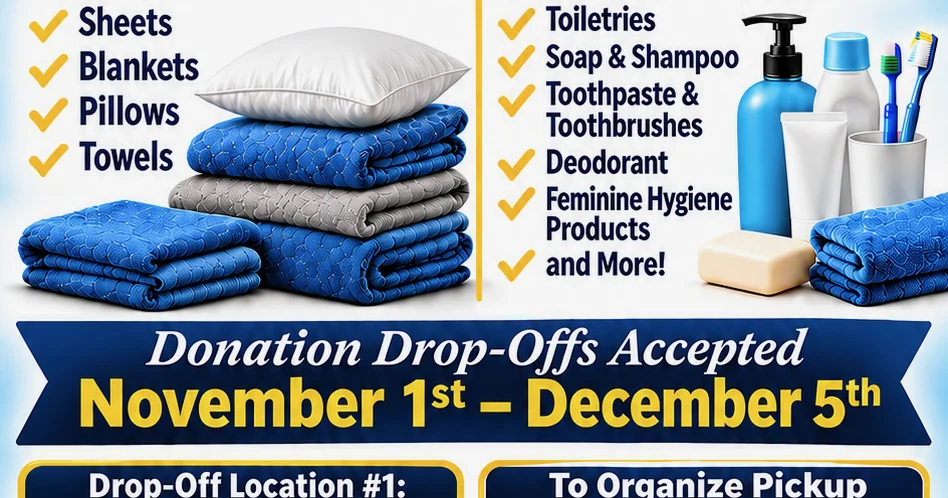
A first-of-its-kind bedding and hygiene drive has been launched to address this gap for individuals entering sober living facilities in Columbia. The “Bedding & Hygiene Drive for Columbia, MO Sober Living Houses” runs from November 1 through December 5. Organizers are requesting new or gently used bedding and linens , including sheets and towels , as well as essential hygiene supplies such as deodorant and soap.
While Columbia has a well-established history of supporting donation drives for items like coats and shoes, Coon noted that this marks the first drive he has encountered in the city specifically focused on sober living residents.
“I’ve never heard of a donation drive for sober living,” Coon said.
Coon estimated that Columbia is home to approximately 50 sober living houses, and suggested the actual number may be even higher. Among the local providers are Fresh Start and In2Action. The Missouri Coalition of Recovery Support Providers’ October directory lists 299 accredited recovery housing beds in Columbia, including 28 designated for short-term respite stays.
Coon acknowledged that sober living facilities and the surrounding communities do not always provide the level of support individuals need as they navigate the path to recovery. He noted that someone leaving rehabilitation might receive assistance with their first week’s rent, only to be left without any guidance or resources for the weeks that follow.
“Then what are you gonna do? Nothing. So you sold me a used vacuum, and it doesn’t even work,” Coon said.
Obligation turned opportunity
Simon Wanyonyi, the founder of the drive, initiated the effort as part of his restorative justice project. A restorative justice project serves as the final community service requirement for graduating from treatment court in Missouri’s 13th Judicial Circuit, which serves Boone and Callaway counties. Participants are permitted to select their own projects, provided those projects address harm connected to their circumstances or meaningfully give back to the affected community.
“For me, I didn’t really have anybody or a particular set of people that I hurt in what I did,” Wanyonyi said. “So, I was realizing that, okay, how can I give back on a large scale?”
Wanyonyi, a graduate of Hickman High School, learned through conversations with Coon and other men in a court-required group at Compass Health that some Columbia sober living residents struggled to afford basic bedding and toiletries. Unlike many individuals within sober living, Wanyonyi had the support of his family , a reality that made the stories he heard all the more striking.
“I’m sitting in the same room as them, going home knowing that there’s an extra toothbrush under my sink,” Wanyonyi said.
Hearing what the men were going without “hurt a little part of my heart,” he said, adding that the idea for the drive “kind of blossomed one night.” Coon helped Wanyonyi develop the concept for his restorative justice project, and Wanyonyi noted that the presiding judge responded enthusiastically and granted approval.
For Coon, the drive has taken on a significance that extends well beyond his responsibilities as community outreach director for the 13th Judicial Circuit Treatment Court Alumni Group.
“This is the first one I’ve really got to dig my hands into,” Coon said.
‘One of our own’
Graduates of Missouri’s 13th Judicial Circuit treatment court established the Treatment Court Alumni Group as a means of staying connected and continuing to support those still working through the program. Coon described the group as a registered 501(c) nonprofit that is actively pursuing grants to fund peer support, community outreach, and recovery planning initiatives. While anyone is welcome to participate, board seats are reserved exclusively for treatment court graduates. Wanyonyi is set to officially join the group upon his graduation.
“This is us helping a graduate, one of our own,” Coon said.
Wanyonyi expressed that he looks forward to having a network of people he can turn to as he determines his next steps following treatment court.
“We all understand the work that it took to get through this program,” Wanyonyi said. “It’s kind of a sense of building a community, like a built-in community without asking for it.”
Coon emphasized his desire for graduates to feel a genuine sense of belonging within that community.
“You did more than just finish a program,” Coon said. “You became a part of a community that does not have to use or drink again.”
Needs and wants
Wanyonyi noted that donations began arriving almost immediately after the first round of flyers, texts, and emails were distributed , before either man had established a system to track incoming contributions.
“I thought it would take a second for people to want to give,” Wanyonyi said.
Within just two days, Coon alone estimated he had collected between 20 and 40 sticks of deodorant and 40 to 50 bars of soap, in addition to bags filled with sheets, pillowcases, and towels. Notable contributors have included The Tiger Hotel and sober living operator Greg DeLine.
The two men planned to tally all donations before Thanksgiving in order to determine which items remained most needed during the final weeks of the drive. In the meantime, both Coon and Wanyonyi indicated they would prioritize women’s hygiene supplies, such as deodorant and lotion. Coon pointed out that Columbia’s sober living houses serving women tend to receive far less attention, and that such toiletry items can represent a significant expense for residents.
With the drive still ongoing, Wanyonyi said he is open to continuing the effort in the following year and has considered maintaining a contact list to reach out to past donors should the drive return. He also expressed that he has been deeply moved to witness people gaining a greater understanding of what sober living entails, what it truly requires for residents to rebuild their lives, and how those realities can challenge common misconceptions surrounding addiction.
“For me, knowledge is power,” Wanyonyi said.
For Coon, the drive is a direct reflection of the values his grandmother instilled in him regarding the importance of looking out for one’s neighbors. When someone in her neighborhood fell ill or had nowhere to turn, she taught him, neighbors came together , offering food, clothing, or shelter.
“And I think that’s what I’m trying to build again,” Coon said.