
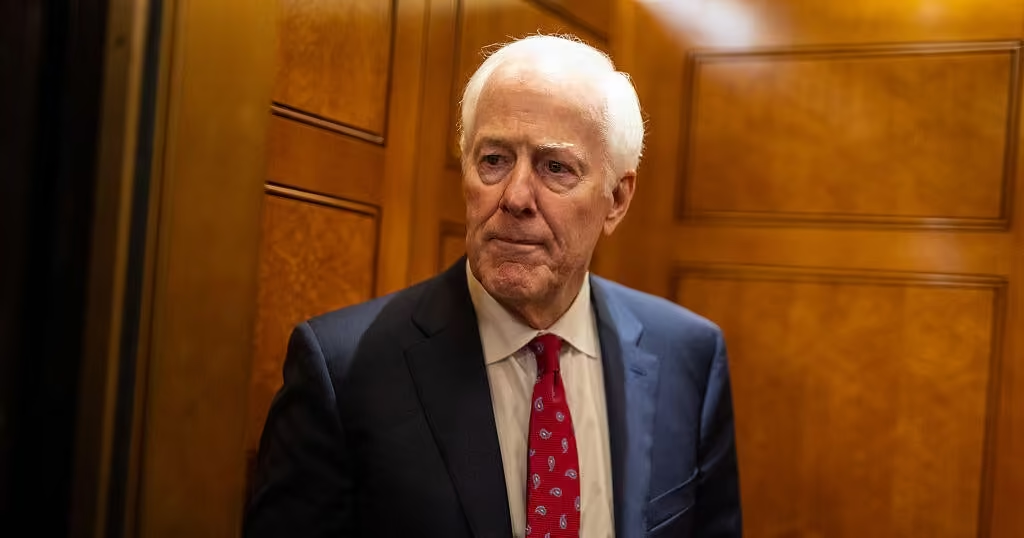
Republican Senator John Cornyn of Texas has formally blocked President Trump’s nomination of T. Elliot Gaiser, a senior Justice Department official, from securing a seat on the federal district court serving the Dallas metropolitan area.
Speaking to CBS News on Capitol Hill, Senator Cornyn confirmed that he had declined to return a blue slip for Gaiser, a procedural move that effectively terminates the nomination’s progress within the Senate Judiciary Committee.
“I think his nomination is no longer viable,” the senator stated. When pressed further on his opposition to Gaiser’s candidacy for the U.S. District Court in the Northern District of Texas, Cornyn elaborated: “He’s not a Texan, has no trial experience, and the White House tried to jam the Senate and wouldn’t allow us to do our due diligence that we need to do on lifetime appointments.”
Gaiser had initially been scheduled to appear before the Judiciary Committee for a confirmation hearing on Wednesday. However, he was ultimately absent from the group of seven federal judgeship candidates who testified before the committee that day.
When asked about Gaiser during an appearance at The Atlantic Summit on Tuesday, Cornyn stated plainly, “He’s not from Texas.”
“That’s a basic problem,” he continued. “The Constitution provides for advice and consent, but there was no consultation whatsoever, no attempt to try to work with the Senate. I’ve offered an alternative, but we’ll see whether they take us up on it. But I think the Senate’s not supposed to be a rubber stamp and … we have been too often.”
The Judiciary Committee’s blue-slip process is intended to facilitate consultation between the White House and the two senators representing a nominee’s home state. In the case of this particular Dallas-area district court vacancy, the relevant senators are Cornyn and Republican Senator Ted Cruz. Once the president selects a nominee, both home-state senators receive a blue slip indicating their approval or disapproval. A senator may also withhold the blue slip entirely, as Cornyn has chosen to do, which is widely regarded as a formal expression of opposition to the nominee.
For a district court nominee to advance and receive a hearing before the Judiciary Committee, both home-state senators must return positive blue slips.
President Trump has previously urged Senator Chuck Grassley, the current chair of the committee, to abolish the blue-slip policy altogether. However, the Iowa Republican has elected to preserve this longstanding tradition as it applies to district court and U.S. attorney nominations.
With Congress now in session for the lame-duck period following the November 3 midterm elections, the Judiciary Committee has been moving swiftly to confirm the remainder of President Trump’s federal judicial nominees before the new Congress is seated in January and Senate control shifts. With Democrats positioned to hold 56 Senate seats, few, if any, of the president’s nominees to federal appeals and district courts are expected to secure confirmation.
President Trump announced last week his intention to nominate Gaiser to serve on the U.S. District Court for the Northern District of Texas, with the formal nomination transmitted to the Senate on Monday.
As Cornyn has noted, Gaiser does not reside in Texas, and his only discernible connection to the state is a one-year judicial clerkship in Houston with a judge on the U.S. Court of Appeals for the Fifth Circuit. A native of Ohio who previously served as that state’s solicitor general, Gaiser resided in Ohio before joining the Trump administration the previous year as head of the Office of Legal Counsel at the Department of Justice.
In his questionnaire submitted to the Judiciary Committee, Gaiser disclosed that he was first contacted regarding the district court vacancy by Senator Cruz’s staff on November 4, one day following the Democrats’ decisive victories in the midterm elections. He indicated that he subsequently discussed a potential nomination with Senator Cornyn’s office on November 6 and was informed by the White House Counsel’s Office on that same date that the president was considering him for the position.
Gaiser’s committee questionnaire is dated November 7, although it was not until November 10 that President Trump publicly announced his intention to nominate him to the district court.
In his capacity as associate attorney general overseeing the Office of Legal Counsel, Gaiser has attracted considerable criticism for several memorandum opinions he has authored. These opinions, which provide legal guidance to the president and federal agencies and are considered binding on the executive branch, have drawn significant scrutiny.
Among the most contentious is an opinion Gaiser authored providing legal justification for U.S. military strikes against vessels suspected of drug trafficking in the eastern Pacific Ocean and Caribbean Sea. Additionally, an April opinion he issued declared the Presidential Records Act , which mandates that the president preserve certain documents and transfer them to the National Archives upon leaving office , to be unconstitutional.
A further opinion issued by Gaiser in August concluded that President Trump’s outside advisers, defined as individuals not employed by the federal government, are shielded from future congressional and legal investigations. In that opinion, Gaiser determined that presidential communications with private individuals outside the government are generally protected under executive privilege.