
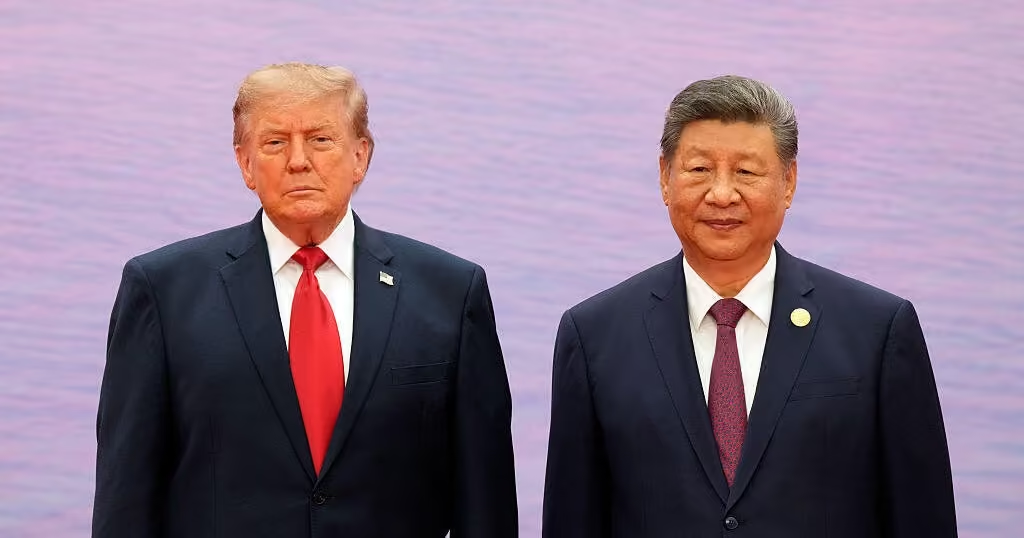
President Trump is scheduled to hold a high-stakes bilateral meeting with Chinese President Xi Jinping in Shenzhen, China, on the sidelines of the Asia-Pacific Economic Cooperation (APEC) summit. The meeting takes place against the backdrop of a growing scandal involving advanced American semiconductor chips allegedly reaching China, as well as deepening internal divisions within the Trump Cabinet regarding how to respond to the situation. The two leaders greeted each other warmly upon Mr. Trump’s arrival in Shenzhen on Wednesday.
This marks the third face-to-face meeting between the two heads of state this year. Their most recent encounter occurred in September, when President Trump hosted President Xi for a three-day summit at the White House. The two leaders are also expected to meet again at the G20 Leaders’ Summit, scheduled to be held at Trump National Doral in Miami in December. The Trump-Xi bilateral meeting is to be followed by a trilateral sit-down involving Mr. Trump, President Xi, and Russian President Vladimir Putin.
Jensen Huang, Alice Huang, and Nvidia
Before departing for Asia, President Trump indicated to reporters that he may raise the matter of Alice Huang , the former Megaspeed executive and suspected Chinese intelligence operative who reportedly had a romantic relationship with former Nvidia CEO Jensen Huang. The Justice Department has been conducting an investigation into Singapore-based Megaspeed over allegations of diverting semiconductor chips to China. President Trump, however, expressed skepticism regarding assessments that Alice Huang is a Chinese intelligence asset.
“I don’t know that she is a spy,” he said. “Usually, what happens with that is that any woman coming to the country, that’s a beautiful woman that comes from China, they say she’s a spy. I don’t know that she was a spy at all. I mean, I really don’t.”
Chris McGuire, a senior fellow for China and emerging technologies at the Council on Foreign Relations, argued that the scandal extends well beyond Jensen Huang’s personal conduct and alleged affairs.
“It’s really kind of unfolded into a much bigger, longer-term scandal that involves the question of how many chips did China get, how porous were export controls, and how did the Commerce Department enforce them?” McGuire said during a phone briefing with reporters on Wednesday. “Which I think is a much more important, longer-term strategic question for the United States, for the U.S.-China relationship than anything involving Jensen Huang’s personal affairs.”
China and Chips
Shortly before the president’s departure for Asia, the Trump administration unveiled new interim trade regulations designed to prevent Chinese artificial intelligence companies from remotely accessing advanced American semiconductor chips. The announcement followed public remarks by Treasury Secretary Scott Bessent, who accused Commerce Secretary Howard Lutnick of deliberately delaying restrictions on Megaspeed , a disclosure that laid bare a significant rift between the two Cabinet members. Bessent told CNBC that President Trump had made clear that China should not have access to the chips in question, while suggesting that Lutnick was resistant to implementing those restrictions. The president declined to take a definitive side in the dispute, telling reporters before his departure that the two men hold “two different views” , one favoring a more conciliatory approach toward China and the other advocating for a more confrontational stance.
“One view is you don’t want to insult China,” Mr. Trump said on Monday. “We have a very good relationship with China, and you don’t want to insult them. And the other view is just go, you know, down and dirty and do what you have to do. Both can say either is wrong or right.”
Ultimately, it was the Treasury Department and the National Security Council , rather than the Commerce Department under Secretary Lutnick , that drafted the new interim rule restricting Chinese companies from remotely accessing the most advanced AI chips housed in data centers abroad, though the rule was formally issued by the Commerce Department.
“This is a very significant action that really cuts off a lot of the avenues that China is using to get AI computing power,” McGuire said. “There was a digital forensic study that was done recently that showed that every single advanced Chinese model is actually trained with the most advanced American chips, so even though these chips have been banned to China, the controls have not been effective. They’ve probably had some impact but not that much.”
McGuire further noted that the measures announced on Monday would have a “really significant” effect on China’s access to computing power, one that “could materially widen the lead” between the United States and China in the field of artificial intelligence.
AI Safety
President Trump has shown no indication of wishing to slow the pace of American AI development in its competition with China. Following the September summit between the two leaders, both governments pledged to establish a dedicated communication channel for sharing information in the event of AI-related incidents or failures. However, Alvin Wang Graylin , a senior fellow on technology with the Asia Society Policy Institute and a digital fellow with the Stanford Institute for Human-Centered AI , cautioned that addressing AI incidents after the fact is far from sufficient.
Graylin expressed hope that President Trump and President Xi would be able to look beyond the current negative news cycle, including the Jensen Huang scandal, and take more substantive steps toward AI safety collaboration by engaging technical experts in working-level discussions.
“I hope that we go beyond just having surface level discussion, and we start to actually create some enduring institutions around safety,” Graylin said.
Taiwan
Prior to his departure for Asia, President Trump was asked by reporters whether the subject of Taiwan would arise during his meeting with President Xi.
“I’m sure he’ll raise it,” the president responded. “I won’t have to raise it.”
David Sacks, a senior fellow for Asia studies at the Council on Foreign Relations , not to be confused with the former White House AI czar of the same name , indicated that he agrees with the president’s assessment.
“I think that it’s very clear that every time Xi sees Trump, they do a little check-in on Taiwan, and Xi Jinping raises his concerns on Taiwan and his expectations of how President Trump will handle Taiwan and cross-strait dynamics,” Sacks told reporters during the Council on Foreign Relations call.
Sacks also noted that a $14 billion arms package to Taiwan remains pending before the president. Earlier this year, the U.S. Navy disclosed that the arms sale had been placed on “pause” to ensure that American forces maintained sufficient munitions in light of the ongoing conflict with Iran. Sacks indicated that congressional pressure to advance the arms package is expected to intensify in the coming months.
“And so, if President Trump is determined to resist that, you know he will need, you know , Xi Jinping will hope to kind of stiffen his spine and say, ‘You’re on the right track, and if you approve this arms package, you’re going to send cross-strait relations reeling.'”
The Trump-Putin-Xi Meeting
Lyle Goldstein, director of Defense Priorities Asia, told CBS News that he views the prospect of a Trump-Putin-Xi trilateral meeting with cautious optimism. While he does not anticipate any major breakthroughs emerging from the initial sit-down, Goldstein suggested that the discussions could lay the groundwork for more productive outcomes in future meetings among the three nations.
“I actually think it could allow for some, not for breakthroughs, but for some movement on major issues,” Goldstein said. “And this is the first time ever that you have this trilateral format for Russia, China, and the U.S. So I would like to see this continue.”
President Trump indicated that he intends to address a broad range of topics with both President Xi and President Putin, including the issue of nuclear disarmament.
“We’re going to talk about denuclearization,” Mr. Trump said. “Tough subject, because it’s very hard for any of us to say we’ll get rid of our nukes, right? Especially since you do have other countries.”
The situation in Iran is also expected to feature prominently in discussions. On Tuesday, President Trump warned that Iran would face severe consequences if it were to detonate a so-called dirty bomb, following a CNN report indicating that U.S. intelligence agencies believe Iran may be developing plans to deploy such a device in the nation’s capital.
Although the White House had initially stated that Ukraine would not be on the agenda for the Trump-Xi-Putin meeting , given the absence of any Ukrainian representatives , President Trump contradicted that position on Monday, telling reporters that Ukraine would indeed be a subject of discussion among the three leaders.
“We’ll talk about my favorite subject, Ukraine,” he told reporters.