
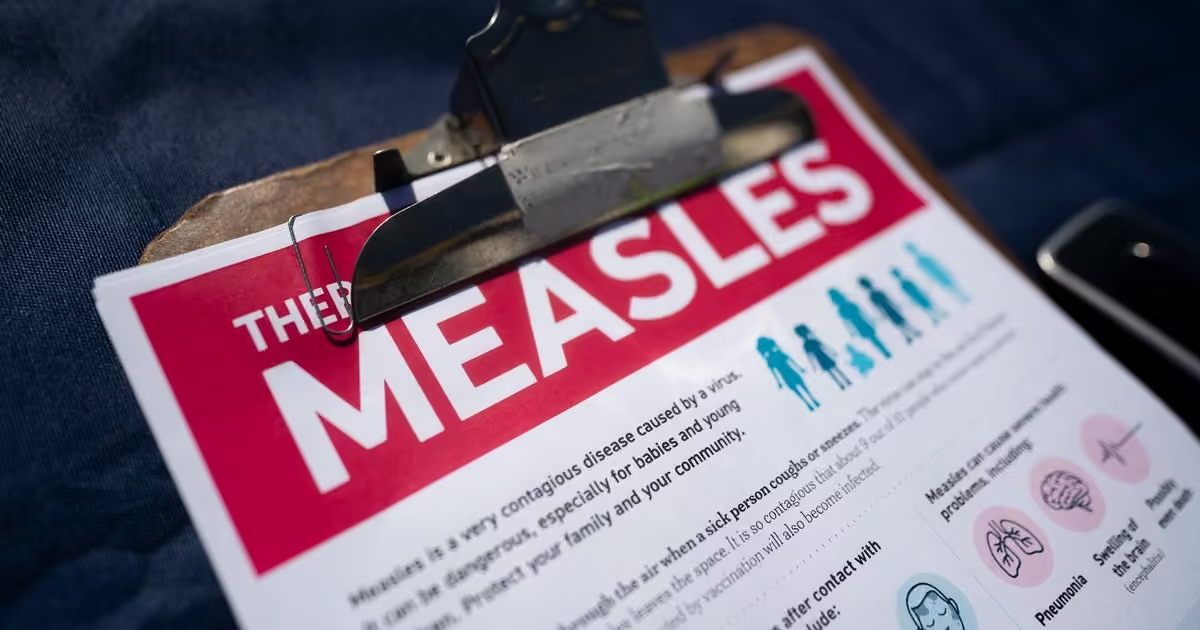
The United States has officially lost its measles elimination status, as confirmed by researchers with direct knowledge of the decision to KFF Health News. The ruling was issued by the Pan American Health Organization following a dramatic surge in measles cases across the country, with more than 5,400 infections recorded so far this year , more than double the total reported in the previous year. The Pan American Health Organization, which serves as the regional office of the World Health Organization for North and South America, is scheduled to hold a formal news conference on Tuesday.
According to the World Health Organization, a country is considered to have eliminated measles when there are no locally transmitted infections or outbreaks persisting for 12 months or longer. The United States has failed to meet this standard for the first time since the year 2000. Data from the Centers for Disease Control and Prevention indicates that approximately one-third of this year’s measles cases are linked to outbreaks that originated in 2025 and have continued to spread into the current year.
Following a 30-year record of 2,242 cases in 2025, the CDC has now tallied 5,412 cases in 2026, resulting in more than 590 hospitalizations and at least six confirmed measles-related deaths, with several states reporting additional fatalities. The most severe outbreak has occurred in Pennsylvania, where state health officials have reported more than 1,500 cases and seven deaths associated with the disease this year. New York and Wisconsin have each reported one additional death. Measles cases have been confirmed in 45 states and Washington, D.C.
What does it mean to lose measles elimination status?
A country or region loses its measles elimination status once population immunity declines to a level at which the disease can sustain ongoing transmission. CBS News medical correspondent Dr. Céline Gounder explained that when a country maintains elimination status alongside high vaccination rates, individual cases or small outbreaks tend to resolve quickly. However, when significant gaps exist in population immunity, the disease can establish sustained chains of transmission.
“It means that we’re at risk of being exposed to measles and getting measles if we’re not vaccinated,” Gounder said. “It means ERs and pediatricians need to consider measles in anyone with a fever and rash, whether they’ve traveled overseas or not. And we may now become an exporter of measles to other countries.”
Dr. Omer Awan, a trained epidemiologist and senior public health contributor for Forbes, characterized the loss of measles elimination status as a significant setback to the nation’s public health infrastructure.
“It’s frustrating and heartbreaking … because we have the tools to fight this. The tool is the MMR vaccine, which we know is 97% effective at preventing the onset of measles,” Awan said. “It’d be one thing if we didn’t have the tools to fight this, but the tools are at our disposal, we just aren’t using the tools that can help us mitigate the spread and beat measles.”
How can the U.S. regain measles elimination status?
A country earns measles elimination status by ensuring there is no local spread of the disease or outbreaks lasting more than one year. The Pan American Health Organization states that the most effective means of maintaining measles elimination is sustaining a national vaccination rate of 95% or higher. Countries are also expected to maintain sensitive surveillance systems capable of detecting cases rapidly, adequate laboratory capacity, and a guaranteed rapid response to outbreaks. All relevant data must be submitted to and verified by the organization.
For the United States to curb ongoing outbreaks and regain elimination status, Dr. Awan emphasized the necessity of returning to higher vaccination rates. He identified the combating of misinformation and the intensification of vaccination campaigns as critical components of that effort.
Data indicates that childhood vaccination rates have declined in numerous communities across the country in recent years, frequently falling below the threshold required to prevent measles outbreaks. Dr. Gounder further noted that legislative action at the state level plays a meaningful role in shaping vaccination outcomes.
“States set the school vaccine rules. Nine states made opting out of vaccination easier in 2025. States ending nonmedical exemptions saw kindergarten vaccination rise 2 to 4 points,” Gounder said. “Most legislatures reconvene in January. Your state lawmakers will write next year’s exemption rules.”
Measles in the U.S.
The United States began collecting national measles data in 1912, according to the Centers for Disease Control and Prevention. During the first decade of that data collection, approximately 6,000 measles-related deaths were reported annually. In the decade spanning 1953 to 1963, nearly every child in the United States contracted measles before the age of 15, with an estimated 3 to 4 million people infected each year and tens of thousands hospitalized. During those years, between 400 and 500 individuals , predominantly children , died from measles annually.
The measles vaccine became widely available in 1963, initiating a sharp and sustained decline in case numbers. Several generations of Americans subsequently grew up without ever encountering the disease. By 1981, reported measles cases had fallen by 80% compared to the prior year, and the country was officially declared to have eliminated measles in 2000.
The United States maintained its elimination status for more than 25 years. This did not signify a complete absence of cases , a 2015 outbreak among unvaccinated individuals was traced to overseas visitors at Disneyland in Southern California, and a 2018-2019 outbreak in New York was eventually contained through public health interventions, including the restriction of vaccine exemptions. However, those episodes represented only a fraction of the transmission now being observed across the country.
The nation recorded 2,242 measles cases in 2025, linked to 48 separate outbreaks, according to CDC data. That year saw 245 hospitalizations, predominantly among children, and three measles-related deaths, with confirmed infections in at least 44 states. It was the highest case count the country had seen in more than three decades. That record was surpassed in 2026, when the United States recorded more than double that number of cases by October, with the total exceeding 5,000 earlier in the month.
Nearly all of the cases have occurred in individuals who were not vaccinated. Measles-related deaths have been reported in Pennsylvania, New York, and Wisconsin. The CDC has reported 43 new outbreaks , defined as three or more related cases , in 2026 thus far, while approximately one-third of this year’s cases are tied to outbreaks that have been ongoing since 2025.
Who is at risk from measles?
Measles is among the most contagious infectious diseases known to medicine. Unvaccinated individuals bear the greatest risk of contracting the disease. CDC data reveals that 96% of people infected with measles in 2026 had either not been vaccinated or were uncertain of their vaccination status, while only 2% of cases occurred in fully vaccinated individuals.
Although many people recover from measles, the disease can cause severe infections of the lungs and brain, potentially leading to cognitive impairment, deafness, or death. Medical research has consistently demonstrated that two doses of the measles, mumps, and rubella vaccine are both highly safe and effective in protecting against measles.
Certain populations , including infants, pregnant women, and individuals with compromised immune systems , are unable to receive the measles vaccine and therefore depend on broad population immunity to prevent exposure. Dr. Awan cautioned that these groups will bear the greatest burden of harm as measles continues to spread.
“They will be the ones that are most vulnerable to getting infected and experiencing the complications,” such as pneumonia or encephalitis, Awan said.