Inside a women’s correctional facility in Vandalia, Missouri, incarcerated mothers are being offered an opportunity that generations of women before them were denied , the chance to raise their newborns while serving their sentences.
The Women’s Eastern Reception, Diagnostic and Correctional Center is home to Missouri’s first prison nursery program, making it one of only ten such initiatives currently operating across the United States.
Nine additional states , California, Illinois, Indiana, Nebraska, New York, Ohio, South Dakota, Washington, and West Virginia , have also established correctional nursery programs within their facilities.
“Motherhood is not easy,” said nursery program manager Kim Perkins. “It’s hard. It’ll break your heart and heal it at the same time.”
Academic research continues to underscore the profound significance of those earliest moments between a mother and her child. According to Harvard University’s Birth Beyond Bars Study, children born to incarcerated mothers are at risk of long-term health consequences stemming from inadequate prenatal care, stressful family environments, and separation from their mothers at birth , circumstances that can disrupt early bonding and prevent breastfeeding.
Prior to the establishment of Missouri’s nursery program, which welcomed its first baby in March 2025, incarcerated mothers throughout the state were separated from their newborns shortly after delivery. Under the current program, eligible mothers may remain with their infants for up to 18 months, during which time they receive parenting education, therapeutic treatment, and practical resources designed to support their transition back into society upon release.
Since the program’s launch in January 2025, 26 babies have been born under its care.
For Margaret “Megan” Sines, the program represents something she has long been searching for , a genuine fresh start.
She describes her nearly nine-month-old son, Noah, as the embodiment of that new beginning.
“He’s my clean slate. He’s my new beginning. And I love him so much,” Sines said.
A bond worth building
Sines shared that she chose the name Noah in reference to the biblical figure whose story symbolizes renewal following catastrophic loss , a metaphor she holds deeply personal after years of battling addiction, which she acknowledges contributed to the circumstances that led to her incarceration.
As a mother of six, Sines expressed that her struggle with addiction had long prevented her from being the parent she truly wanted to be to her five older children.
“I’ve always been a mom, but I’ve never had the chance to be a mother,” Sines said.
Today, she is experiencing motherhood in an entirely different light.
Sines explained that being able to breastfeed Noah, witness his development, and tend to his needs each day has allowed her to cultivate a maternal bond she previously found difficult to access.
“Being able to care for a child and having that attachment and the emotions that come with it… there’s no feeling to describe how awesome it is,” Sines said.
A systematic review published in the National Library of Medicine identified the first hour following birth as a particularly sensitive period for both mothers and newborns, noting that early skin-to-skin contact plays a meaningful role in supporting bonding and breastfeeding.
Perkins emphasized that providing incarcerated mothers with the opportunity to experience those critical early milestones is central to the program’s mission.
“Motherhood. Wow. It’s probably the most special bond that you can have,” Perkins said. “The expansion of your heart and inside your body. Inside your soul.”
A mother of twins, Perkins became a single parent following the death of her first husband in 2016. She has spoken openly about how that experience instilled in her a profound appreciation for perseverance , a value she now actively imparts to the women participating in the nursery program.
“There were days when I didn’t want to wake up or didn’t want to get out of bed or go to work or do any of those things,” Perkins said.
Now remarried, Perkins maintains that her children remain the most important people in her life and continue to inform her approach to her professional responsibilities.
“This program is built to change lives. It’s built to change generational lives,” Perkins said.
Sisterhood behind bars
Although the nursery operates within the confines of a correctional facility, Perkins noted that staff have made deliberate efforts to cultivate a warm, home-like atmosphere for mothers and their children.
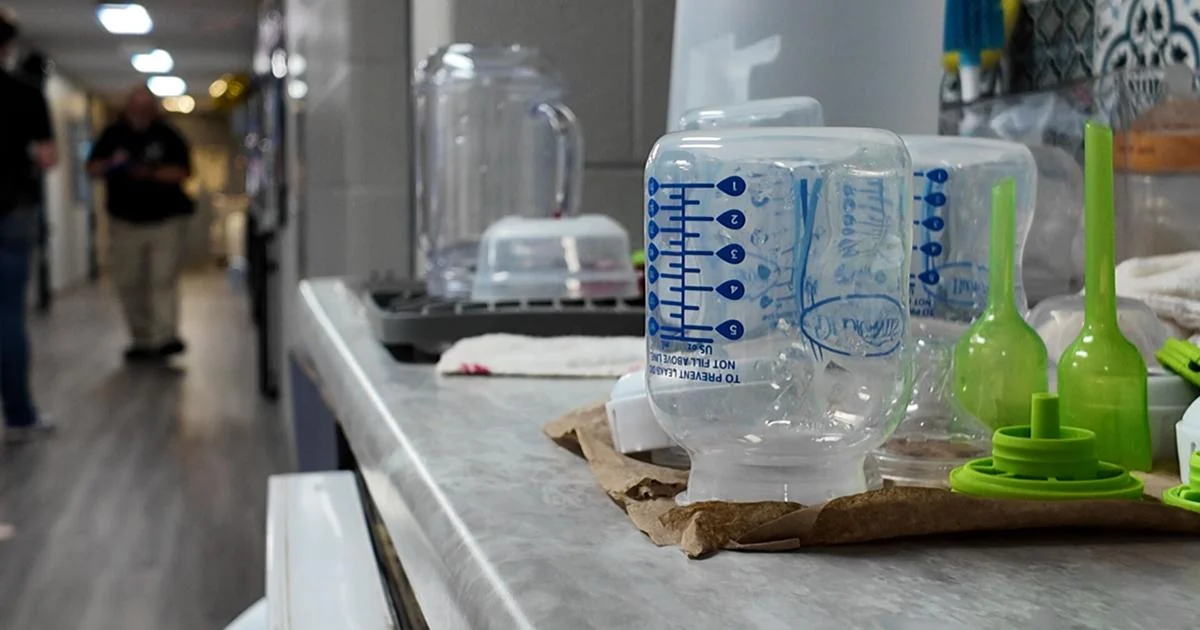
The two-floor wing features a shared living room, kitchen, nursery, educational space, and a clothing room where mothers may select outfits for their babies through a take-and-return system. Mothers are also able to prepare baby food, breastfeed, and mark holidays and birthdays alongside their children.
Yet for Sines, the most meaningful aspect of the program is not found within any particular room , it is the relationships she has formed with fellow participants.
“Just the sense of sisterhood here,” Sines said. “Being there for each other and being there for each other’s babies, for the hard times, for the good times.”
Sines credited the other mothers in the program with helping her confront personal insecurities, develop parenting skills, and grow more comfortable seeking support when needed.
Additional support is provided by incarcerated women who serve in designated caregiver roles within the nursery. At the time of the facility’s visit, nine caregivers were actively serving in the program, though the nursery has capacity for up to ten. These individuals apply and interview for their positions, undergo training in childcare, CPR, and first aid, and offer supervision while mothers attend treatment sessions, educational classes, or appointments. They also serve as mentors, drawing upon their own lived experiences with motherhood.
For 45-year-old Shanna Hawkins, the sense of community within the nursery proved especially vital during a period of serious illness. Hawkins, a mother of three, underwent two surgeries and 20 radiation treatments while incarcerated. During her recovery, fellow women in the nursery assisted her with cooking, laundry, and dressing when she was physically unable to manage these tasks independently.
“Sometimes they don’t have to ask for help because sometimes something will happen and we’re all there. Like, what can we do? Can we help you?” Hawkins said.
Fellow caregiver Micheala Stokes-Smikle, a mother of two daughters, shared that she has similarly discovered a deep sense of purpose in supporting women navigating experiences that mirror her own. Having personally experienced postpartum anxiety following the birth of her first child, Stokes-Smikle said she was able to offer meaningful guidance to a mother who was struggling to accept help with her newborn.
“I know what you’re feeling and I know what you’re going through,” Stokes-Smikle recalled telling her.
For both women, the program has evolved into something far greater than a role or responsibility. It has become an opportunity to support other mothers while simultaneously developing skills and insights they intend to carry with them beyond incarceration.
A future beyond the walls
For Perkins, the program’s ultimate purpose extends well beyond its physical boundaries. Her hope is that every mother who participates leaves with a stronger bond with her child and the foundational tools necessary to build a stable, fulfilling life after release.
To that end, the program offers access to GED preparation, college coursework, vocational training, financial literacy education, and life skills instruction.
Stokes-Smikle, who has been incarcerated for nearly four years, noted that her work in the nursery has also helped her prepare emotionally for the eventual reunion with her own daughters, aged six and seven.
“Whenever it comes to motherhood, it’s kind of like building as you go,” she said. “It’s not going to be the same situation every day, and there’s a lot that comes with it that can be emotional and it can be very trying.”
Hawkins, who was preparing for release at the time of her interview, expressed that she intends to maintain the relationships she has formed with the mothers and babies she encountered through the program.
“I’m going to miss a lot of it, but I’m ready to be home with my own kids, too,” Hawkins said.
For Sines, the path forward means returning home with Noah and continuing to build upon the progress she has made throughout her time in the program. Her five older children currently reside with relatives, an adoptive family, and a family friend. She reflected that her experience with Noah has revealed to her the depth of her own capability as a mother.
“This program has helped me with all my self doubt, knowing that I actually can do it and I’m worth it,” Sines said.
While she acknowledges that her journey remains ongoing, she hopes her story serves as a source of encouragement for other mothers facing addiction or difficult life circumstances , a reminder that transformation is within reach.
“Just know there is hope,” Sines said.