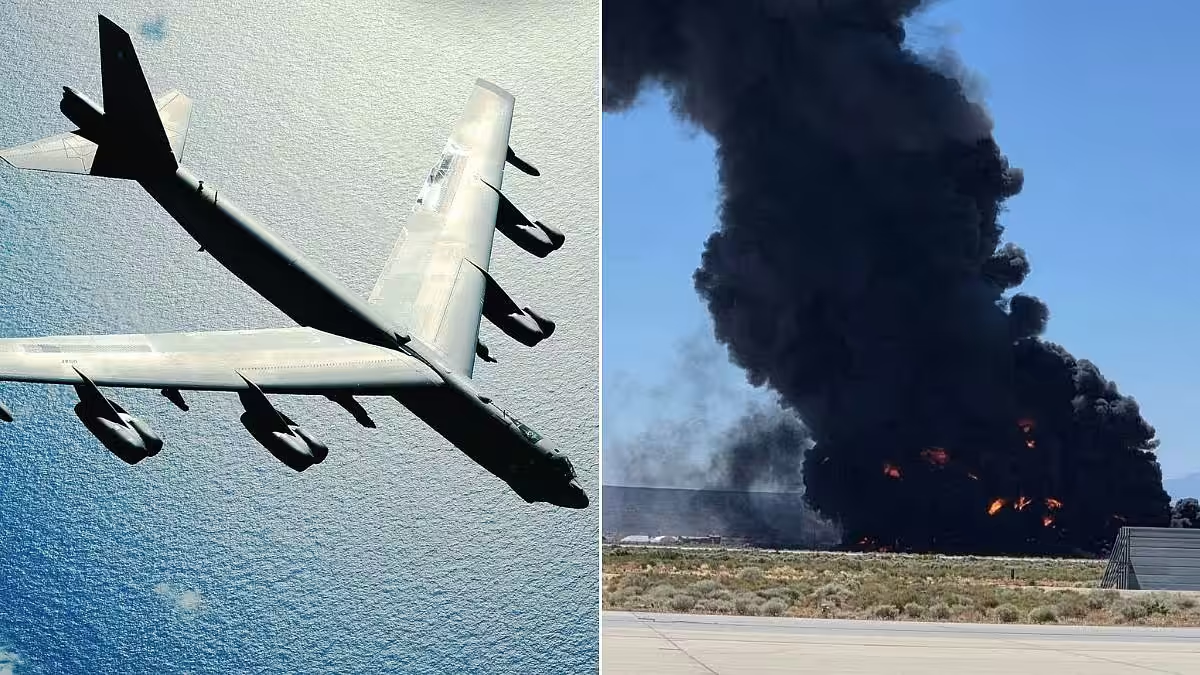
Eight crew members aboard a B-52 bomber that crashed shortly after takeoff Monday morning at a U.S. Air Force base in Southern California’s Mojave Desert are believed to be dead, the Air Force said.
“Initial indications are that the crash was not survivable,” Edwards Air Force Base, north of Los Angeles, posted on social media. Officials said the cause of the crash is under investigation.
There was no information yet on the crew, however aerial footage showed virtually nothing left of an aircraft.
Emergency crews responded after the aircraft went down around 11:20 a.m. A large swath of charred desert near what appeared to be a runway at Edwards Air Force Base sent up black smoke, with emergency vehicles stationed nearby. The military hasn’t said whether the bomber was armed.
The Boeing B-52 Stratofortress is a long-range bomber that entered service in 1955. Built to carry both conventional and nuclear weapons, it has seen use in U.S. military conflicts from Vietnam to Iran.

The airfield remained closed by Monday afternoon, and all inbound aircraft were being diverted.
Officials suspended non-commercial visitor passes for the base “to allow the installation to focus entirely on emergency response operations,” according to a statement.
Edwards Air Force Base, home to a large portion of the U.S. Air Force’s aircraft test and development efforts, sits about 161 km north of Los Angeles.
The 412th Test Wing, which runs the base, also conducts developmental testing of all Air Force aircraft, weapons systems, software and components before the service purchases them as well as throughout their lifespan.
The vast desert base is also where Air Force test pilot Chuck Yeager broke the sound barrier in 1947, reaching a speed of Mach 1.05.
The way the B-52 crashed so quickly after takeoff, without climbing very high or traveling far, makes aviation safety expert Jeff Guzzetti suspect some kind of flight control malfunction. But he says it’s too soon to say what might have caused the control problem.
He said the controls could have been rigged wrong after maintenance, or the crash could have stemmed from a catastrophic engine problem or the failure of a piece of equipment being tested.
“I think it was definitely a controllability issue. Now, whether that was tied to an engine failure, a flight control failure, or some new testing device failure, I’m not sure,” said Mr. Guzzetti, who used to investigate crashes for both the Federal Aviation Administration and the National Transportation Safety Board.
Although the Air Force has been flying B-52 bombers for more than 70 years, testing out new equipment on a plane can create new challenges.
“A flight test is always riskier than normal operations, so that’s why you have specially trained test pilots, and you should have other safety protocols,” Mr. Guzzetti said.